
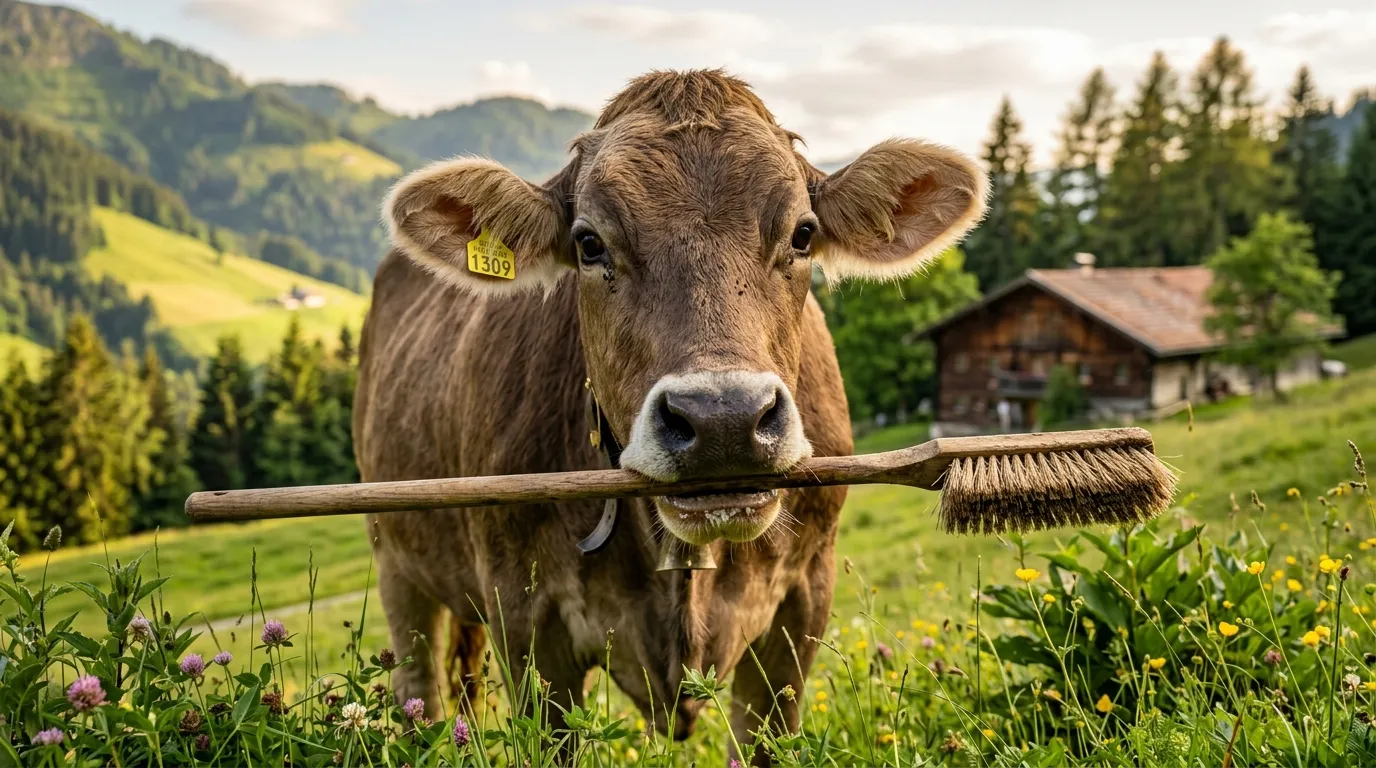
In the Austrian village of Notsch im Gailtal, a 13-year-old Swiss Brown cow named Veronika has been doing something that researchers thought only chimpanzees could do consistently: using a single tool for multiple purposes, selecting different ends of it depending on the task at hand. When she wants to scratch the thick skin of her back, she picks up a deck brush with her tongue, secures it sideways in her mouth, and scrubs with the bristled end. When she shifts to the softer, more sensitive skin of her udder and belly, she flips to the smooth wooden handle and applies gentler pressure. This is not random fidgeting. It is deliberate, context-sensitive, multipurpose tool use, and according to a study published this week in Current Biology, it has never been experimentally documented in any species of livestock.
The paper, authored by cognitive biologists Antonio Osuna-Mascaro and Alice Auersperg at the University of Veterinary Medicine Vienna, is modest in length but sweeping in its implications. If a cow, an animal most people associate with grazing and not much else, can demonstrate the kind of flexible cognition that we have spent decades studying in great apes and corvids, then our understanding of where intelligence lives in the animal kingdom may be far more limited than we think.
What Veronika Actually Does
The researchers recorded 76 instances of self-directed tool use across seven sessions of 10 trials each. In each trial, they placed a deck scrub brush in front of Veronika in varying orientations and filmed what happened next. She used her long, prehensile tongue to lift the brush, then secured it laterally in the diastema, the natural gap between her front incisors and rear molars that all cattle have. This created a stable grip that gave her precise control over the distal end of the tool, the part doing the scratching.
The data showed a clear pattern. Veronika preferentially used the bristled end when targeting her rump, loin, and back, areas covered in thicker skin that can handle vigorous scrubbing. When she moved to her lower body, including the udder and belly, where the skin is thinner and more sensitive, she switched to the smooth handle end and applied lighter, more careful strokes. She also adjusted her movement intensity: broader sweeping motions for the upper body, slower and more precise ones below.
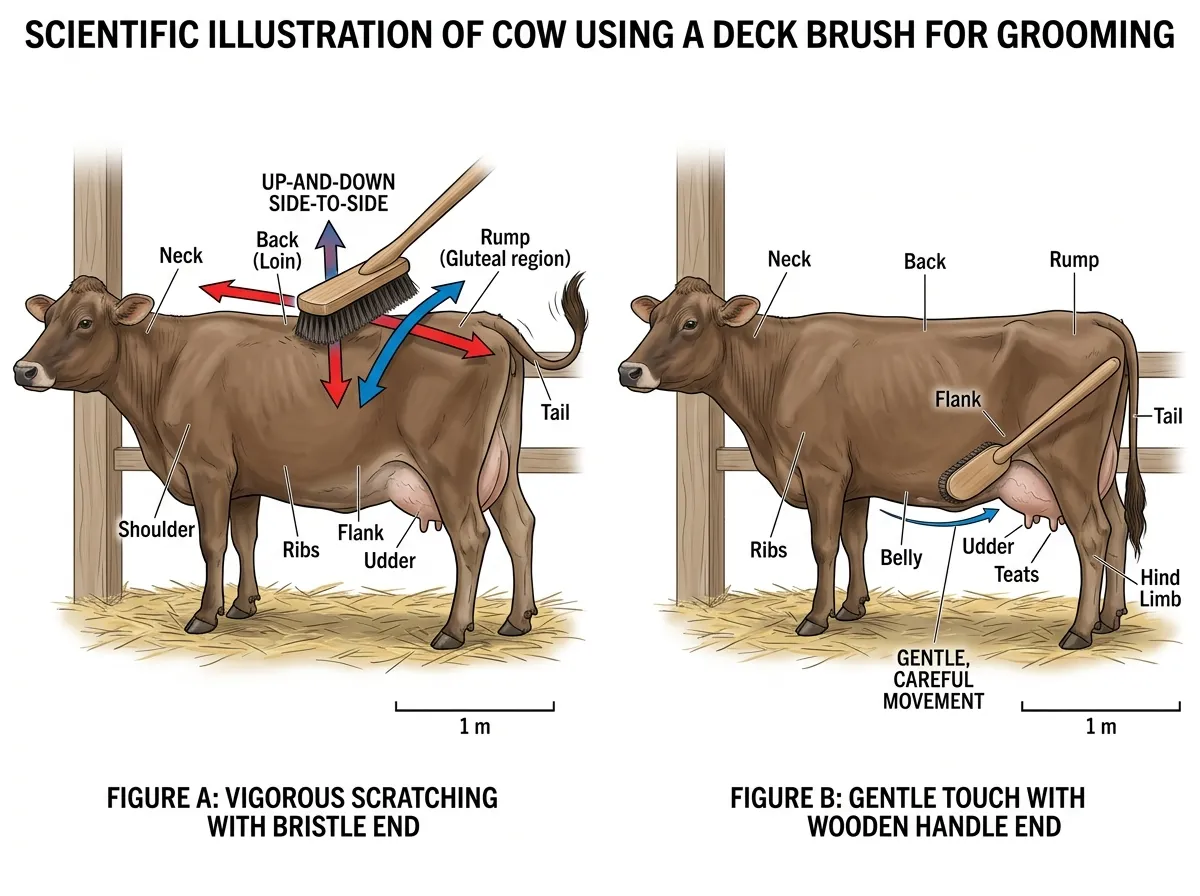
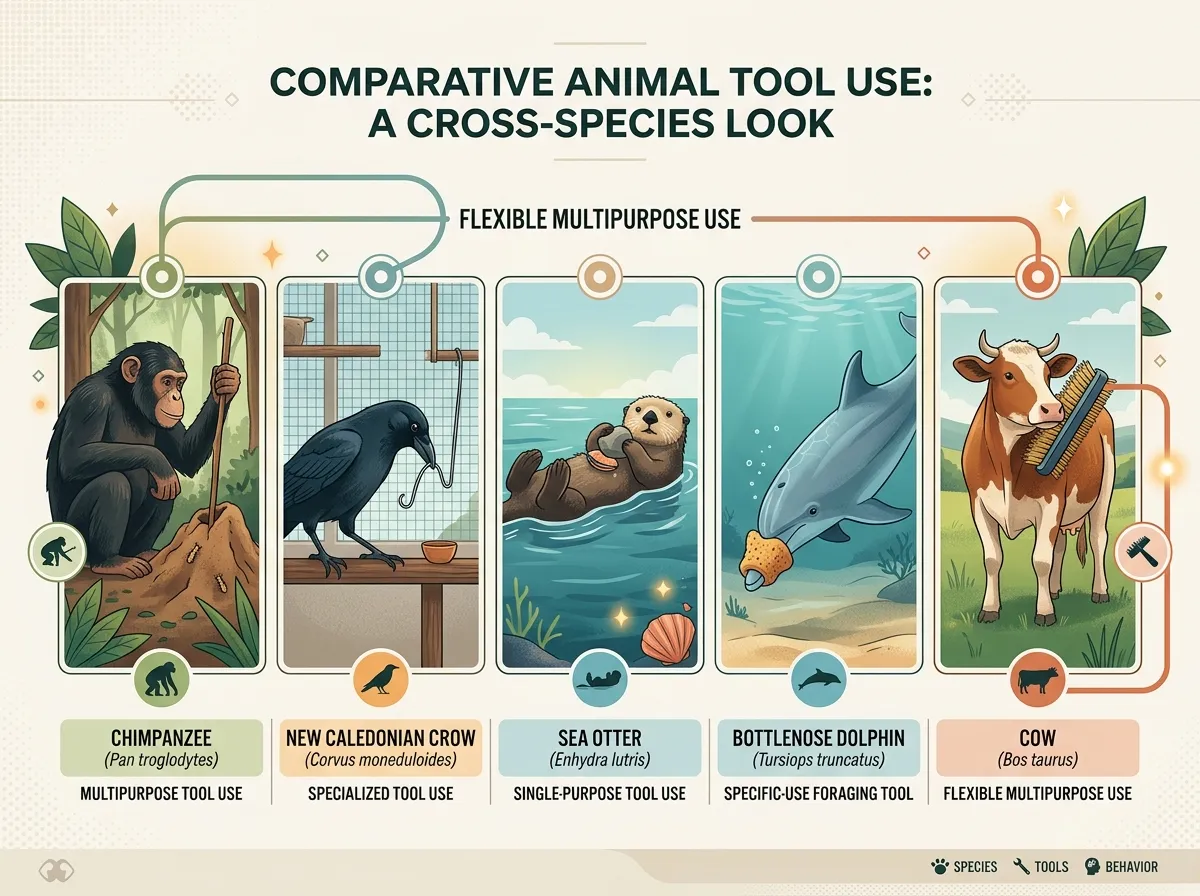
"Veronika uses different parts of the same tool for different purposes," Osuna-Mascaro explained. This distinction matters because it separates her behavior from simpler forms of tool use, like a sea otter banging a rock against a shellfish. Single-purpose tool use, while impressive, does not require the animal to evaluate the tool's properties and match them to a specific task. What Veronika does is closer to how a chimpanzee in the Congo Basin uses one end of a stick to open a hole in a termite mound and the other end to fish the insects out. Before this study, that kind of flexible, multipurpose tooling had only been consistently documented in chimps.
The Cognitive Puzzle of Cattle
The finding is surprising partly because cattle have received almost no serious attention from cognitive science. Researchers have spent decades investigating tool use and problem-solving in primates, corvids (crows and ravens), cetaceans, and parrots. Each discovery in those lineages generates excitement because it pushes the boundary of what we consider sophisticated cognition. But no one was looking at cows.
This is not because cattle are assumed to be unintelligent in any formal scientific sense. It is because the conditions under which most cattle live, confined in feedlots or managed in commercial herds, do not provide opportunities for complex behavior to emerge. A cow standing in a concrete pen with nothing to manipulate has no reason or means to demonstrate tool use, even if the cognitive capacity is there.
Auersperg, the study's senior author, put it directly: "This was a meaningful example of tool use in a species rarely considered from a cognitive perspective." The implication is not that Veronika is an exceptional genius among cows. It is that we have been testing the wrong environments, not the wrong animals.
What Made Veronika Different
Veronika's biography reads like a case study in how environment shapes cognitive expression. She is owned by Witgar Wiegele, an organic farmer who keeps her as a companion animal rather than a production unit. She has lived for 13 years, far longer than most dairy cows, who are typically culled before age six. She has daily contact with humans and access to what the researchers describe as "an engaging physical landscape" with a variety of manipulable objects scattered around her environment.

Her tool use did not appear overnight. She initially taught herself to scratch using fallen branches, experimenting with sticks and other objects she encountered in her daily wandering. The researchers later provided her with purpose-built tools like rakes and brushes, which she adopted and used with increasing sophistication. The behavior developed over years, not days. It required sustained access to objects, the freedom to explore, and enough time alive to iterate.
This biographical detail is scientifically significant because it mirrors a finding that runs across species: cognitive complexity is not just a matter of brain anatomy. It requires the right environmental conditions to express itself. A crow raised in a bare cage does not make tools. A chimp without social learning opportunities may never develop the termite-fishing technique. Veronika's case suggests that cattle may belong to a much larger club of cognitively capable animals whose potential is simply never tested.
Ancient Roots, Hidden Capacities
The researchers propose that the capacity for complex problem-solving, including tool use, "might have ancient evolutionary roots" that predate the divergence of many modern mammalian lineages. In other words, the neural architecture needed for flexible tool use may not be a specialized adaptation that evolved independently in primates, corvids, and a few other lineages. It may be a more general capability that was present in a common ancestor and has been preserved, dormant and unexpressed, in species whose environments never demanded it.
This is a provocative hypothesis, and the researchers are careful to present it as a possibility rather than a conclusion. A single individual does not prove a species-wide trait. But the logic is compelling. We know that distantly related species, from crows to dolphins to elephants, have converged on similar problem-solving behaviors. The conventional explanation is convergent evolution: each lineage invented intelligence separately. The alternative, that something like general problem-solving capacity is far older and more widely distributed than we assumed, would reshape how we think about animal cognition at its foundations.
Veronika's case alone cannot settle this debate. But it adds a data point from an unexpected direction. If flexible tool use can emerge in a domesticated ungulate given the right conditions, the bottleneck for animal intelligence may be opportunity rather than hardware.
The Ethical Shadow
The study does not explicitly address animal welfare, but the implications are difficult to ignore. If cattle possess the cognitive capacity for flexible problem-solving, planning, and context-sensitive decision-making, then the environments in which the vast majority of the world's approximately one billion cattle live become harder to justify. Factory farming is predicated partly on the assumption that livestock animals have limited subjective experience and minimal cognitive needs. Every piece of evidence that challenges that assumption raises the moral stakes.
Research on animal cognition has been moving in this direction for years, with studies showing that fish have social preferences, that octopuses can solve sequential puzzles, and that pigs can learn to play video games. Veronika's contribution is not just another entry in the growing catalog of animal intelligence. It is a particularly inconvenient one, because it concerns the species most central to global agriculture.
The researchers have invited the public to report similar observations in other cattle, acknowledging that anecdotal evidence of tool use in livestock may already exist but has never been systematically collected. If Veronika's behavior turns out to be replicable under similar conditions, the scientific conversation will shift from "can cattle use tools?" to "what else have we been missing?"
The Deeper Question
What Veronika's case ultimately challenges is not just our understanding of cows but our assumptions about where to look for intelligence in the first place. Cognitive science has historically focused on species that are either closely related to humans or obviously "smart" by human standards: apes, dolphins, parrots, corvids. This selection bias has produced a map of animal intelligence that may say more about our research priorities than about the actual distribution of cognitive abilities in nature.
A 13-year-old cow on an Austrian farm, given time and tools and the freedom to experiment, developed a behavior that we have built entire research programs around in primates. She did it without training, without social learning from other tool-using cattle, and without any evolutionary pressure that would specifically favor this ability. If the conditions for intelligence are that general, the question is no longer which animals are smart. It is which animals we have never bothered to ask.
Sources
- Flexible Use of a Multi-Purpose Tool by a Cow01597-0) - Current Biology
- This Cow Uses Tools Like a Primate, and Scientists Are Stunned - ScienceDaily
- Meet Veronika, the First Cow Known to Engage in Flexible, Multipurpose Tool Use - Scientific American
- No Bull: This Austrian Cow Has Learned to Use Tools - Science / AAAS