
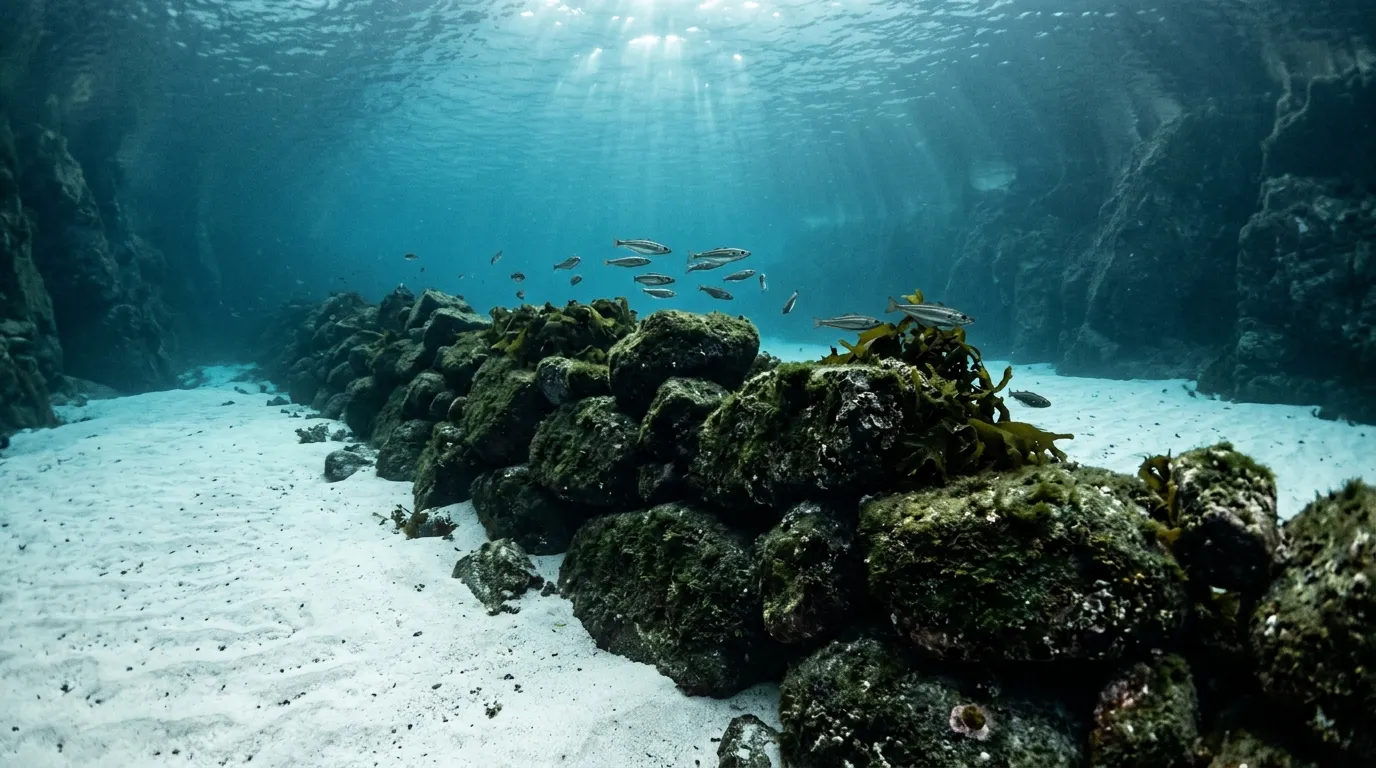
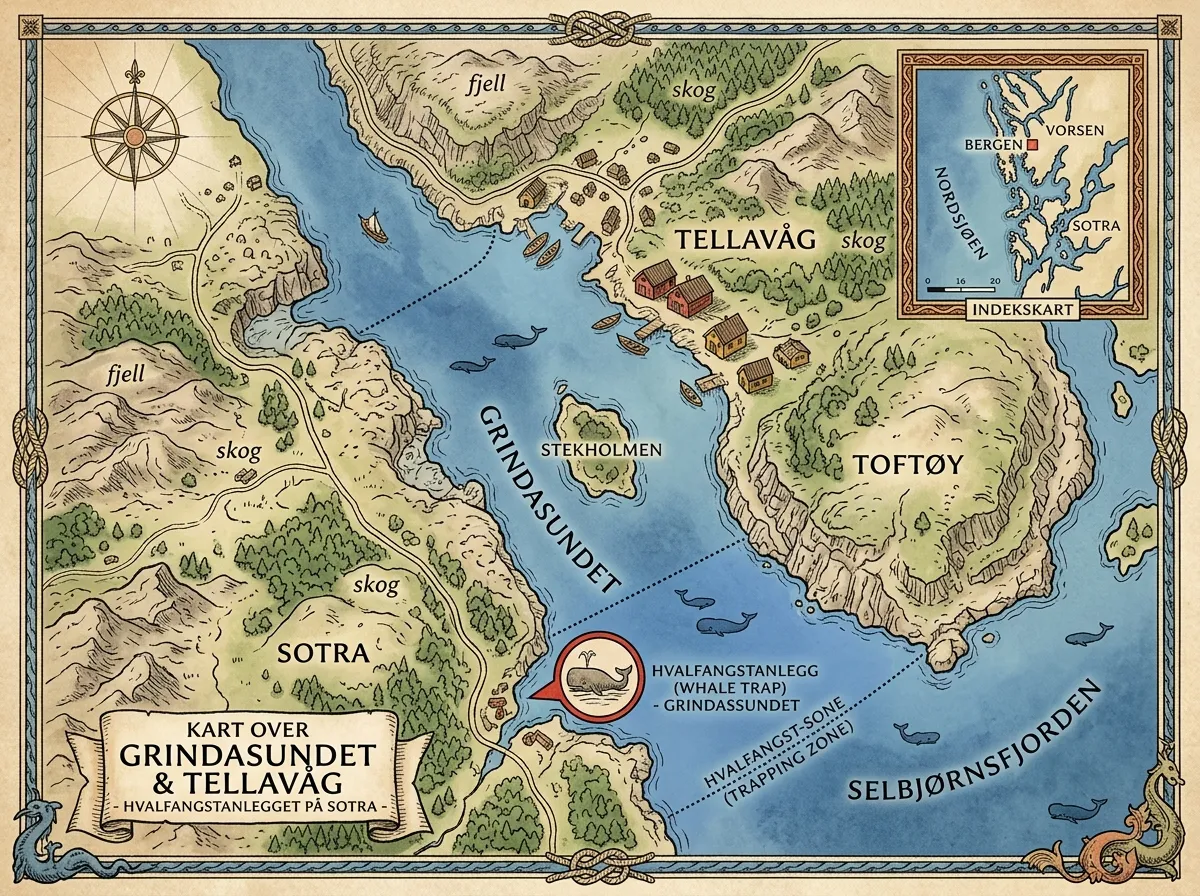
The seabed of Grindasundet was clean sand. The marine archaeologists had been surveying the narrow strait by boat, towing sonar equipment through water roughly 15 meters deep, mapping what they expected to be an unremarkable stretch of seafloor near the village of Telavag in western Norway. Then, at the southern end of the strait, the sand stopped and the stones began. A distinct belt of rocks, more than 25 meters long and up to 9 meters wide, stretched across the channel. The stones were stacked, clearly placed by human hands, in a location where natural geology offered no explanation for their presence.
"We saw a distinct belt of stones that ran across the strait," said Elling Utvik Wammer, a marine archaeologist at the Norwegian Maritime Museum who leads the project. "It was exactly what we had hoped for."
What they had hoped for was the first physical underwater evidence of a whale trap described in the Gulating Law, the oldest record of Norwegian law, dating to the 900s AD. Written sources from the medieval period and the 1500s described gates and barriers built across narrow straits to trap whales inside bays. Drawings and accounts from the 1700s and 1800s filled in the operational details. But no one had ever found the actual structure underwater. After more than a thousand years, the stones on the seafloor at Grindasundet appear to be what remains of it.
What the Gulating Law Says About Whales
The Gulating assembly was the supreme legal body for western Norway from approximately AD 900 to 1300, convening annually in Gulen, on the coast north of Bergen. The Older Gulating Law, likely first codified during the reign of Olaf the Peaceful (1066-1093) though drawing on earlier oral tradition, covered everything from Christian religious practice to inheritance disputes. Preserved in seventeen manuscripts, the most complete being the Codex Rantzovianus (c. 1260) held at the Danish Royal Library, it also contains detailed provisions about whaling.
Freeholders could hunt whales exceeding 18 ells, approximately eight to ten meters. Other men could pursue whales only half that size. Finders of beached whales had to document the carcass through witness-observed butchering. Landowners claimed half when animals were processed on their property. A 40-mark fine applied to anyone who hunted whales "in a shoal of fish," disrupting the fishing that communities depended on. And the law explicitly mentions driving whales into bays as an established practice in western Norway.
Until the Grindasundet discovery, these provisions existed in a vacuum of physical evidence. Historians knew that whale-trapping was practiced and regulated. They knew where some of the trapping sites were. They knew the legal framework that governed the distribution of meat. What they lacked was the structure itself: the barrier, the gate, the physical installation that made the whole system work.
"This is the first time this type of physical cultural evidence has been found underwater and linked to a tradition described in the Gulating Law," Wammer explained.
How You Trap a Whale With Rocks and Rope
The method, reconstructed from accounts of the same practice at nearby Skogsvagen, was communal, elaborate, and brutal. When someone spotted whales entering the bay, the call went out. The first priority was blocking the strait. One entrance had a permanent barrier made of timber and rope, weighed down with stones. The other was closed with a whale net. The target species was the minke whale, seven to ten meters long and weighing up to nine metric tons.
Once the whales were sealed inside, the killing began. "After that, they began to shoot the whales with crossbows and arrows infected with bacteria from spoiled meat," Wammer explains. The infected arrows weakened the animals over hours or days. When the whales were sufficiently exhausted, they were harpooned, pulled to shore by dozens of rowing boats, and finally killed. An eyewitness account from 1885 published in Stories of Coastal Norway recorded that "many harpoons were torn out while the whales were being hauled to land. Some wounded animals swam around for several days before they were finally killed."
The carcasses were butchered at a designated site called Kvalvollen within a rock-lined enclosure. The meat was divided among everyone who participated according to a complex system of rules codified in the law. The whale's eyes were removed and thrown back into the water. "This was believed to ensure that future generations of whales would find their way back into the bay," Wammer said. The ritual suggests roots that extend well beyond the written record, possibly into pre-Christian Norse practice.
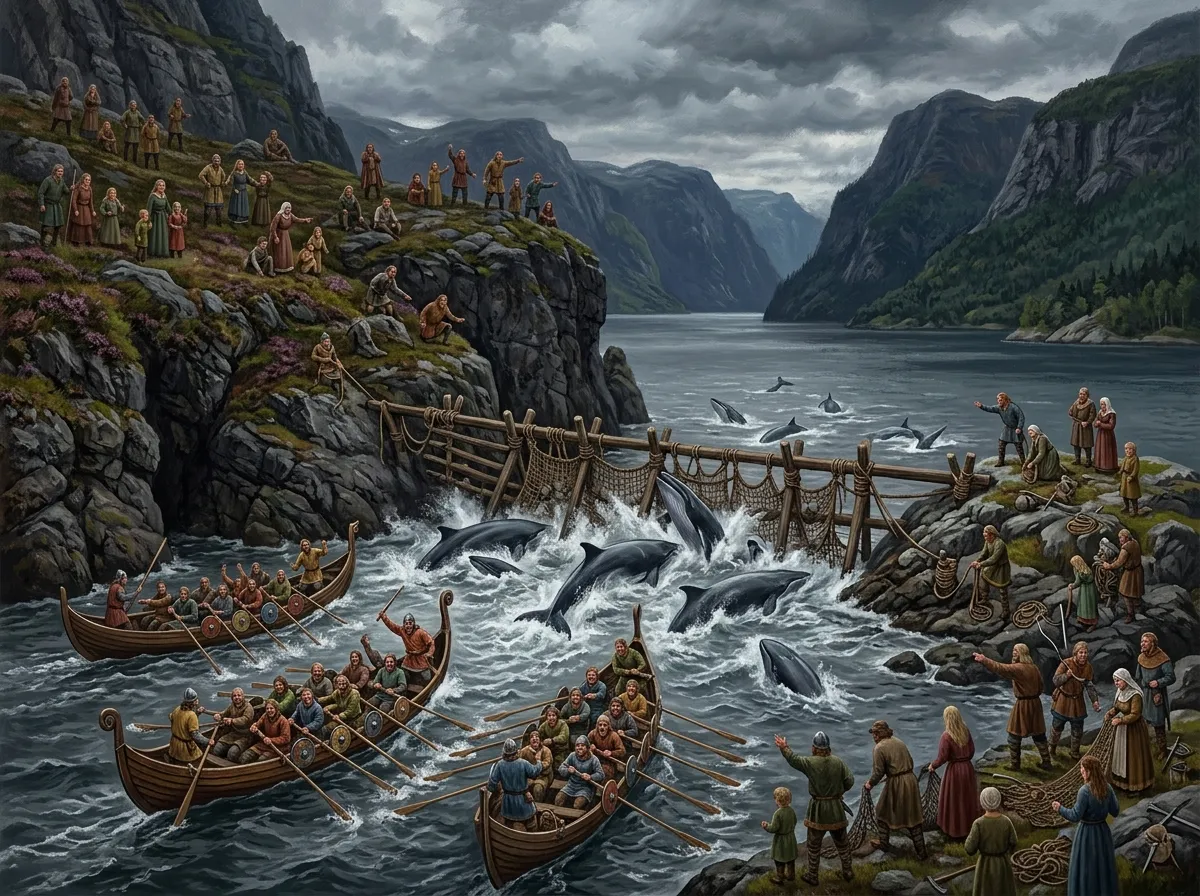
Wammer characterized it as "an archaic form of hunting in which people from the entire village participated." He acknowledged the suffering involved but noted that attempting to harpoon large whales more quickly from small boats would have been dangerous. "All forms of historical hunting and trapping involved some level of suffering for the animals that were killed. What may be unusual about this practice is that it could drag on for several days."
What the Stones Tell Us
The belt of stones at Grindasundet sits exactly where historical sources place the barrier. The strait is about 60 meters wide and divided by a small islet called Stekholmen, a name that derives from Old Norse stika, meaning "to block with stakes." The etymology alone tells you what the islet was used for.
Beside the stone belt, the team also found a large circular mound of rocks, 15 meters across and 4 meters tall. Researchers are "fairly certain" this is the remains of an 18th-century attempt to replace the aging timber barrier with a permanent stone wall. The priest Andreas Christie documented in the 1700s that the plan was abandoned because it was "too large an undertaking" and "would have required enormous amounts of rock."
"It shows how much effort people were willing to invest to avoid building the barrier," Wammer said. "It also reflects how much work the barrier itself must have required, which in turn says something about how important whaling must have been."
The importance is confirmed by the ownership records. In the Middle Ages, Nonneseter Monastery in Bergen, the richest female convent in Norway and wealthier than many male convents, held rights to the bay at Telavag. Whaling was likely a primary reason. When a Cistercian nunnery controls the trapping rights, the economic value of the operation is beyond doubt.
Ice Diving and GoPro Archaeology
The fieldwork itself was an exercise in adaptation. The team, a collaboration between the Norwegian Maritime Museum, Bergen Maritime Museum, and Stavanger Maritime Museum under the IRMAS inter-regional research program, conducted dives in January 2026. Local residents helped them break through ice to reach the site. The cold was an advantage: winter water contains minimal algae, providing crystal-clear visibility for documentation.
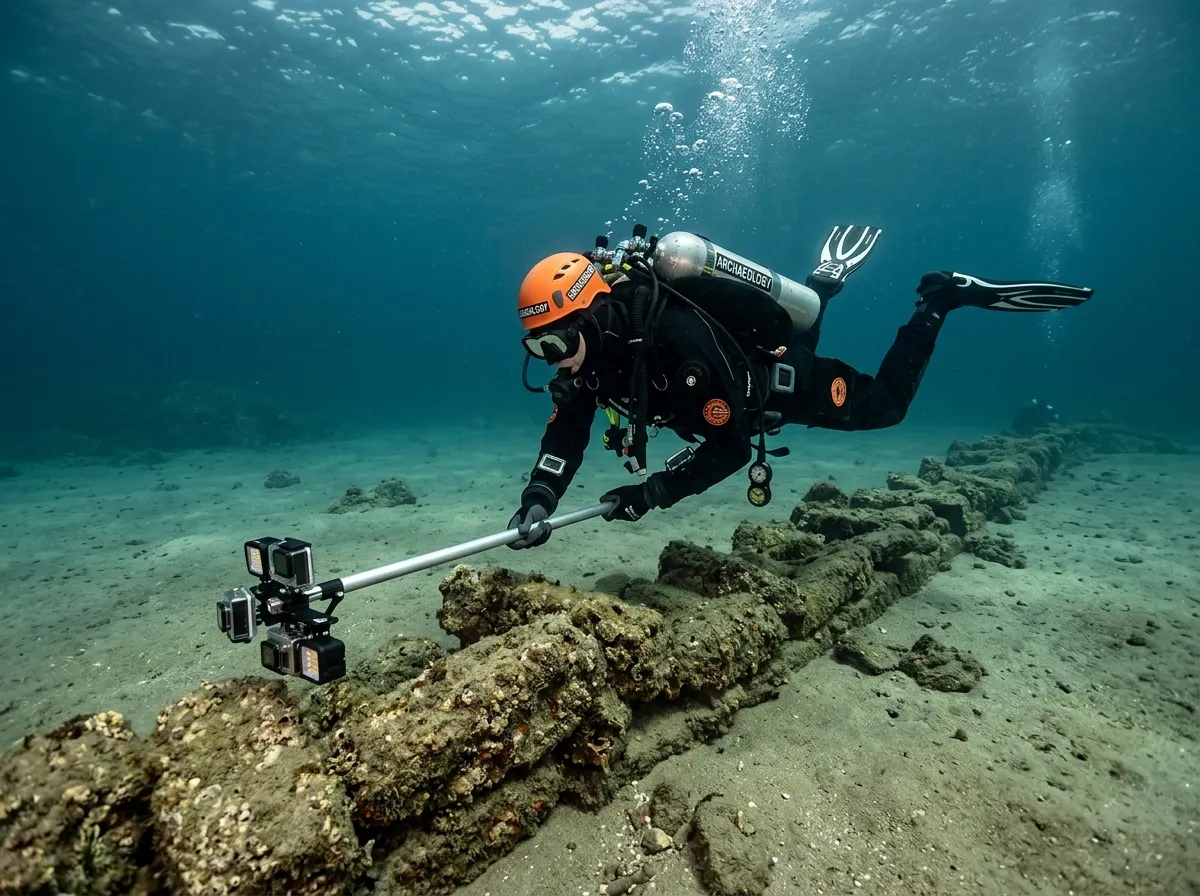
Marine archaeologist Christopher F. Kvastad documented the site using a pole with two GoPro cameras that took photographs every second. By swimming slowly in systematic patterns over the formations, the team captured imagery from enough angles to build 3D photogrammetric models of the entire structure. Wammer calls the method "revolutionary, especially underwater, since dive time is so limited." The 3D models were assembled by Beatrice Frabetti of IRMAS and will form the basis of a scientific article expected by autumn 2026.
The sheer quantity of stone surprised the researchers. "What's surprising is the sheer amount of rock," Wammer noted. "They must have brought boats to the site and dumped stones over the side." The logistics of transporting, placing, and maintaining a barrier large enough to block a 60-meter strait, in addition to the timber framework and rope, point to a communal infrastructure project that required sustained investment from the entire settlement. The Oygarden region, where Telavag is located, has the highest number of coastal trapping sites in Norway, suggesting this was not a single community's innovation but a regional system.
The Deeper Question
The whale trap at Grindasundet sat on the seafloor for a thousand years, invisible beneath the same water that carried the whales into the bay. The Gulating Law described it. Sixteenth-century writers confirmed it. Eighteenth-century priests tried to replace it with stone. Nineteenth-century observers watched the last hunts conducted nearby. And yet until January 2026, nobody had put a camera on it.
Marine archaeology moves slowly, constrained by cold water, limited dive time, and the simple difficulty of seeing what lies beneath the surface. The Oygarden region alone contains numerous trapping sites that have never been surveyed underwater. The team plans to return in June 2026 to continue fieldwork, examining not only other whale trapping installations but also fishing sites where stone walls and nets were used to corral herring and cod.
What the Grindasundet stones confirm is something the written sources only implied: that medieval Norse communities built permanent infrastructure for whale hunting on a scale that required legal regulation, institutional ownership, communal labor, and ritualized distribution. The barrier was not improvised. It was maintained across centuries, controlled by monasteries, governed by law, and passed down through generations. The 9th-century merchant Ottarr reportedly told King Alfred of England that he had caught "more than sixty whales in two days," likely pilot whales driven into shallow inlets using a similar method. The practice may have been carried to Iceland by Norwegian settlers and adapted for the fjords there.
The whale's eyes, thrown back into the water so the next generation would return, are the most haunting detail. They speak to a relationship with the natural world that was simultaneously pragmatic and ritualistic, extracting everything the animal had to offer while performing an act of superstition or hope that the resource would renew itself. The stones on the seabed are the physical proof that this relationship was not metaphorical. It was built with timber and rope, regulated by law, and anchored, literally, in rock.
Sources
- Science Norway: "Large man-made belt of stones discovered underwater in Norway: 'Very unusual'" - Primary source with extensive Elling Utvik Wammer quotes and methodology details
- Heritage Daily: "Ancient Whale Trap Discovered Beneath Norwegian Seabed" - Discovery overview and Gulating Law connection
- Archaeology Magazine: "Traces of 18th-Century Whale Trap Found in Norwegian Waters" - Archaeological context and Andreas Christie documentation
- The Debrief: "'Very Unusual' Underwater Structure in Norway Linked to 1,100-Year-Old Records" - Technical details on sonar mapping and photogrammetry methods
- Interesting Engineering: "World-First Medieval Whale Trap Discovered" - Broader context on Norse whaling history and Nonneseter Monastery connection