
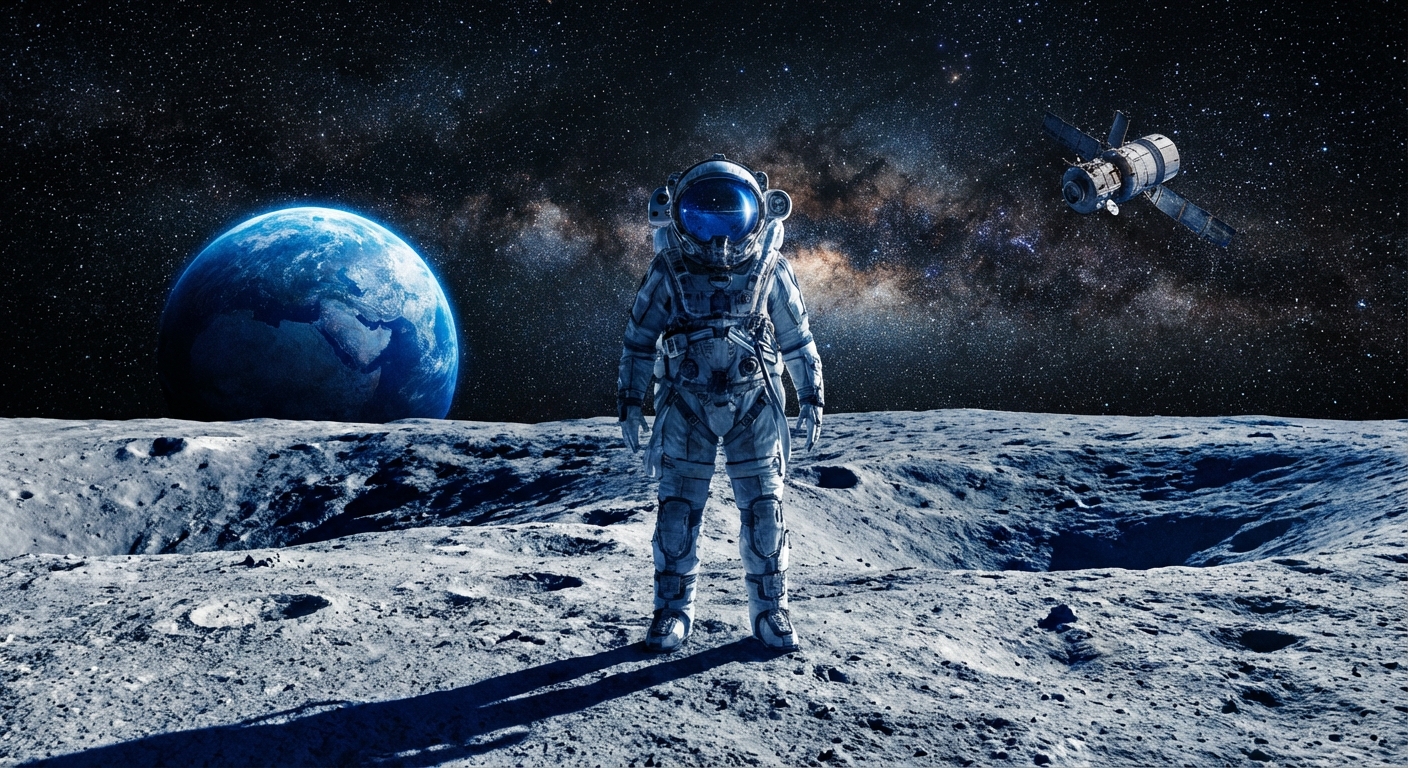
The last time humans walked on the Moon, Richard Nixon was president, the Vietnam War was winding down, and the personal computer had not yet been invented. That was December 1972, when Apollo 17 astronauts Eugene Cernan and Harrison Schmitt spent three days exploring the Taurus-Littrow valley. In the fifty-plus years since, no human has ventured beyond low Earth orbit. But as 2026 begins, that extraordinary hiatus is finally ending.
This year stands as perhaps the most significant inflection point for human spaceflight since the Apollo era. NASA’s Artemis program is poised to return astronauts to the lunar surface. Private companies are building their own space stations. And the serious planning for crewed Mars missions has moved from science fiction to engineering reality. To understand where we are headed, we need to examine each of these developments, understanding not just what is happening but why it took so long and what it means for humanity’s future beyond Earth.
The Artemis Program: Back to the Moon, This Time to Stay
The Artemis program represents NASA’s most ambitious human spaceflight endeavor since Apollo, but with fundamentally different goals. While Apollo was a Cold War sprint to beat the Soviet Union, Artemis is designed as the foundation for a permanent human presence beyond Earth. The program’s name comes from the Greek goddess of the Moon and twin sister of Apollo, signaling both continuity with the past and a new chapter in lunar exploration.
The cornerstone of Artemis is the Space Launch System (SLS), the most powerful rocket ever built. Standing 322 feet tall, the SLS produces 8.8 million pounds of thrust at liftoff, about 15 percent more than the Saturn V rockets that carried Apollo astronauts to the Moon. Unlike its predecessor, SLS uses a mix of liquid hydrogen and solid rocket boosters, drawing on technologies developed for the Space Shuttle program. The Orion spacecraft that sits atop SLS carries up to four astronauts and is designed for missions lasting up to 21 days.
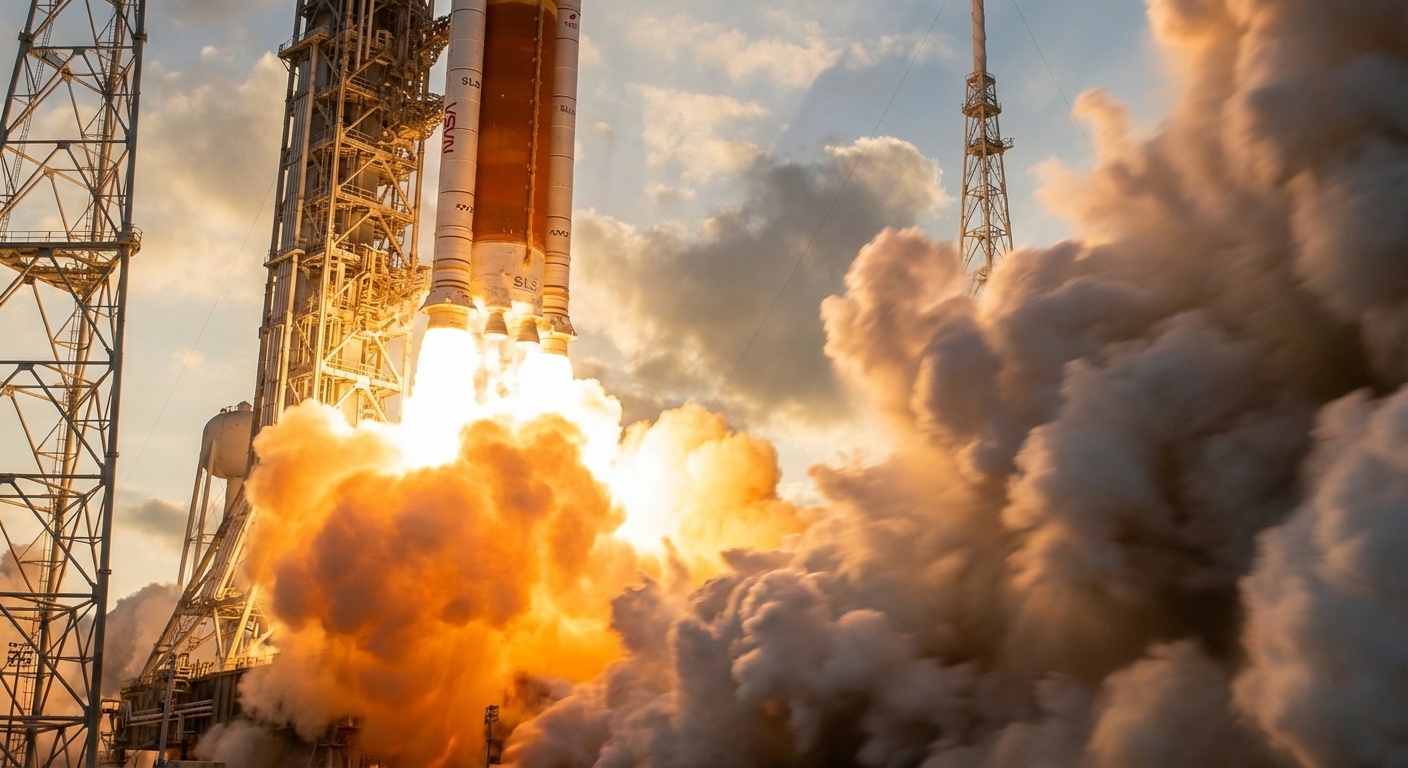
Artemis II, which flew in late 2024, sent four astronauts around the Moon in a trajectory similar to Apollo 8, demonstrating that the integrated SLS-Orion system could safely carry humans on deep space missions. The mission reached a point 6,400 miles beyond the Moon’s far side, setting a new record for the farthest distance traveled by humans from Earth. Artemis III, planned for later this year, aims to land the first woman and first person of color on the lunar surface near the Moon’s south pole.
The choice of the south pole is strategic. Unlike the equatorial regions visited by Apollo astronauts, the lunar south pole contains permanently shadowed craters where temperatures never rise above minus 400 degrees Fahrenheit. In these eternal night zones, water ice has accumulated over billions of years, delivered by comets and asteroids. This ice is not merely scientifically interesting; it represents rocket fuel. Water can be split into hydrogen and oxygen, the same propellants that power most rocket engines. A lunar base that can harvest local water ice would not need to lift all its propellant from Earth’s deep gravity well, dramatically reducing the cost of further exploration.
Private Space Companies: The New Space Race
The space industry of 2026 looks radically different from even a decade ago. Where government agencies once held a monopoly on human spaceflight, private companies now operate crewed missions as routine services. This transformation was not inevitable; it required deliberate policy choices and billions of dollars in investment, but the results have exceeded most predictions.
SpaceX stands at the center of this transformation. Elon Musk founded the company in 2002 with the explicit goal of making humanity a multi-planetary species. After early rocket failures that nearly bankrupted the company, SpaceX achieved something the established aerospace industry thought impossible: developing reusable orbital rockets that land themselves. The Falcon 9 first stage now routinely returns to Earth, landing either on drone ships at sea or back at the launch site. This reusability has cut launch costs by roughly a factor of ten compared to expendable rockets.
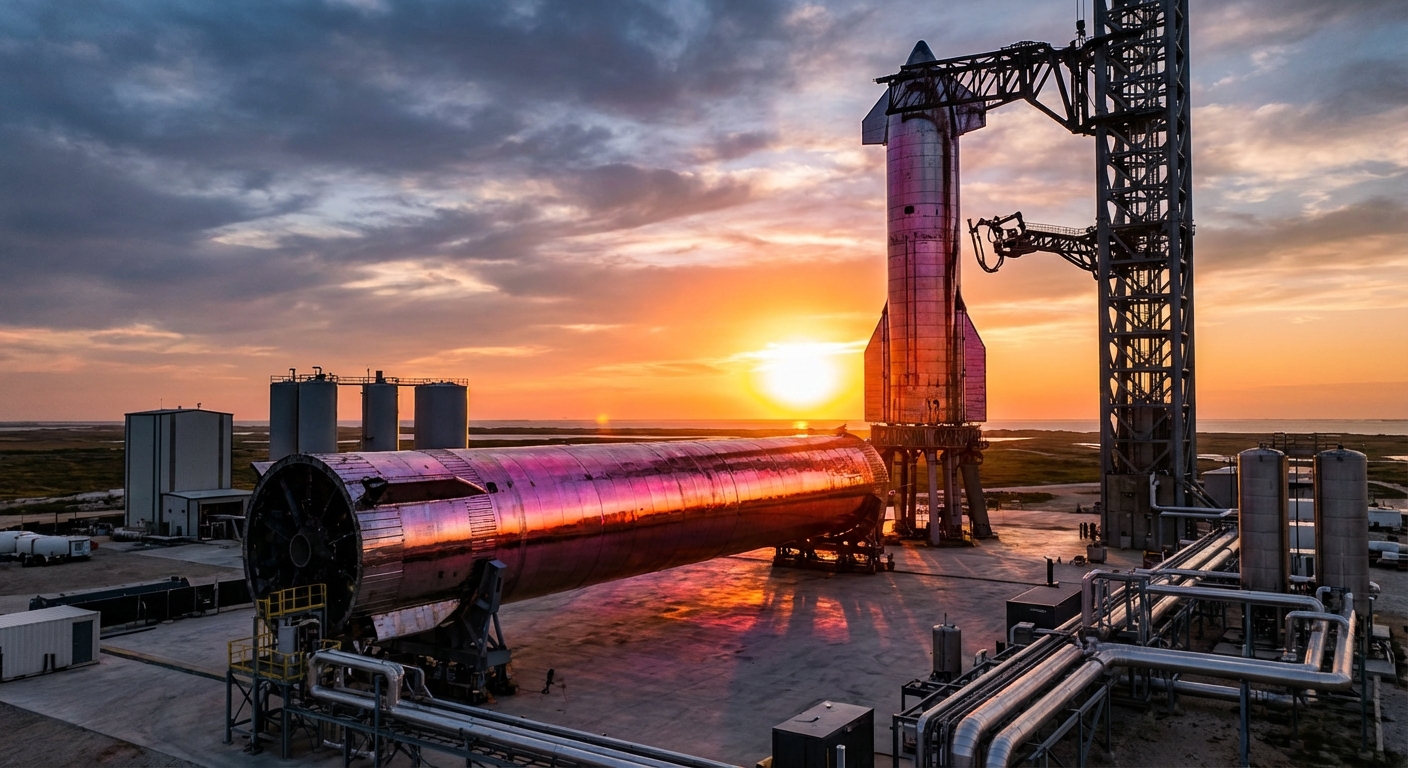
But Falcon 9 is merely a stepping stone. Starship, SpaceX’s fully reusable super-heavy lift vehicle, represents the company’s bid to make Mars colonization economically feasible. Standing nearly 400 feet tall when mated with its Super Heavy booster, Starship can carry over 100 tons to orbit and, critically, is designed to be rapidly reusable like an aircraft. If SpaceX achieves its cost targets, Starship could reduce the price of launching cargo to orbit from thousands of dollars per kilogram to merely tens of dollars. At those prices, ambitious projects like lunar bases and Mars settlements become financially imaginable.
SpaceX is not alone. Blue Origin, founded by Amazon’s Jeff Bezos, is developing its own heavy-lift rocket called New Glenn and has been selected by NASA to build a lunar lander for later Artemis missions. The company’s philosophy differs subtly from SpaceX’s Mars-focused vision. Bezos sees space industrialization as a way to move heavy industry off Earth, preserving our planet as a residential and natural zone while mining asteroids and manufacturing in orbit. Boeing and Lockheed Martin continue to operate through their United Launch Alliance joint venture, though their business model increasingly focuses on national security launches rather than commercial innovation.
Perhaps most significantly, multiple companies are now building commercial space stations to eventually replace the aging International Space Station. Axiom Space has already attached commercial modules to the ISS and plans to detach them into an independent station by the end of the decade. Vast and Orbital Reef are developing their own stations from scratch. This matters because technology shapes how we live, and the architecture of these stations will determine what kinds of activities, from research to manufacturing to tourism, become possible in low Earth orbit.
Mars: The Horizon Goal
If the Moon represents humanity’s current frontier, Mars represents the next one. The red planet has captivated human imagination for over a century, from H.G. Wells’s invading Martians to the canals Percival Lowell thought he saw through his telescope. Today, Mars exploration has moved from fantasy to engineering challenge, though one of staggering complexity.
The journey to Mars takes between six and nine months, depending on the alignment of the planets, which occurs roughly every 26 months. This means a round trip, including time on the surface, would take about two and a half years at minimum. Astronauts would face cosmic radiation without Earth’s protective magnetic field, muscle and bone loss from prolonged microgravity, and psychological stresses that no human has experienced. If something goes wrong, there is no quick return home and no possibility of resupply.
NASA’s current architecture for human Mars missions depends on technologies being developed for Artemis. The Gateway, a small space station in lunar orbit, will serve as a testbed for deep space life support systems. Operations on the lunar surface will develop techniques for living off local resources. The Moon becomes a proving ground for Mars, close enough that astronauts can return home in days if problems arise, yet challenging enough to stress-test technologies that must work flawlessly millions of miles from Earth.
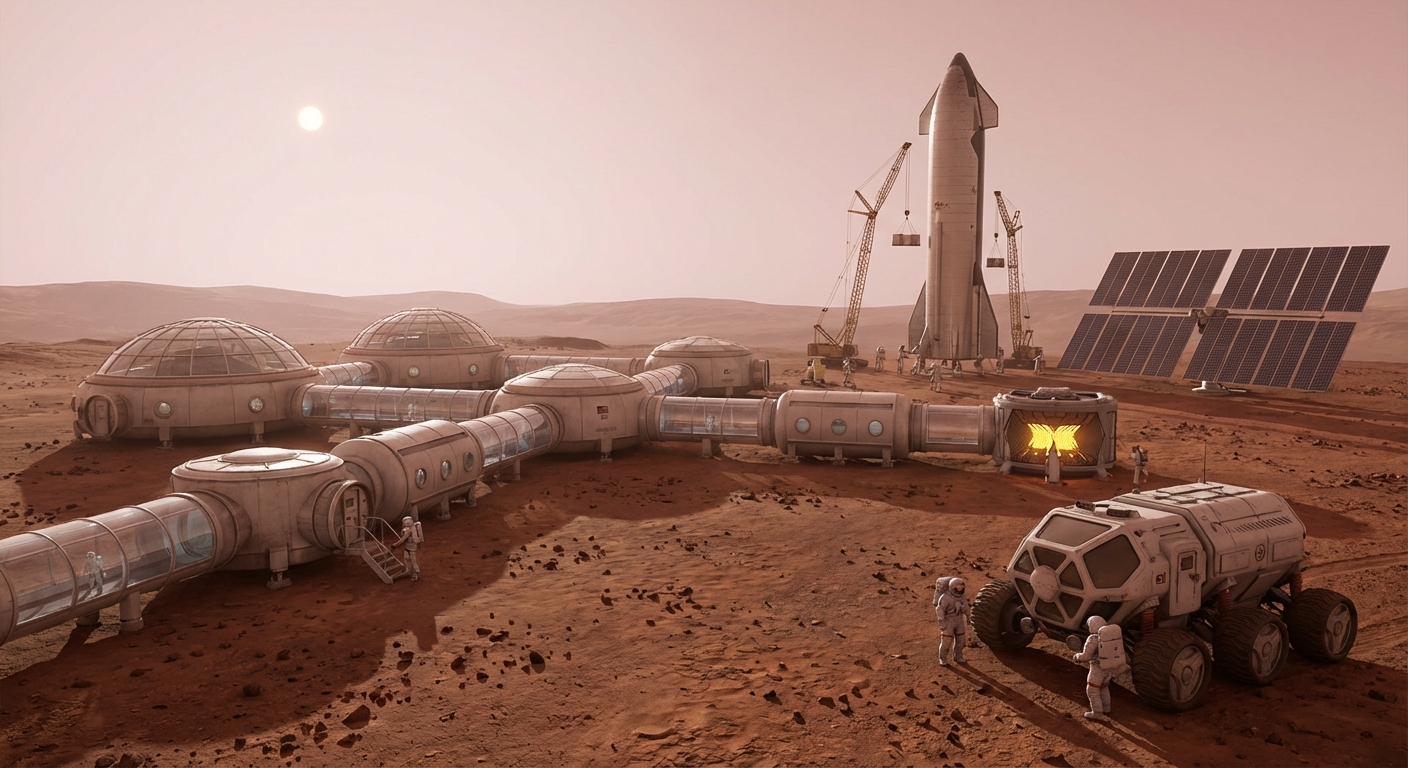
SpaceX has published its own Mars plans, characteristically more aggressive than NASA’s timeline. Musk envisions sending Starships to Mars during every planetary alignment, gradually building up the infrastructure for a self-sustaining city. The company’s internal target of landing humans on Mars by the late 2020s strikes many experts as optimistic, but SpaceX has a track record of achieving things others considered impossible, if sometimes on a delayed schedule. What was once dismissed as corporate marketing has become a plan that NASA takes seriously enough to incorporate into its own thinking.
The scientific value of human Mars exploration is immense. While robotic rovers have transformed our understanding of Mars, they move slowly and cannot perform the kind of complex geological investigations that trained humans can accomplish in hours. The central question, whether Mars ever harbored life, may require human explorers to answer definitively. Finding even microbial fossils on Mars would transform our understanding of biology and suggest that life might be common throughout the universe.
The Economics of Space
Space exploration has always been expensive, but the economics are shifting in ways that could make ambitious goals achievable. Understanding these economic factors helps explain why space activity is accelerating now rather than continuing the slow pace of the post-Apollo decades.
The fundamental economic problem with space is the tyranny of the rocket equation. To escape Earth’s gravity, a rocket must carry propellant, but that propellant has weight, which requires more propellant to lift, which requires more propellant, and so on. This exponential relationship means that for every kilogram of payload delivered to orbit, a rocket must burn roughly 50 kilograms of propellant plus the mass of the rocket structure itself. Reusability attacks this problem by eliminating the need to build a new rocket for every flight. Just as airlines would be ruinously expensive if they threw away the airplane after each trip, spaceflight becomes affordable only when vehicles can be reused hundreds or thousands of times.
Beyond launch costs, the economics of what happens in space are also changing. The value of space extends beyond exploration itself, connecting to communications, Earth observation, and increasingly manufacturing. Pharmaceutical companies have shown that certain protein crystals grow better in microgravity, potentially enabling new drug development. Fiber optic cables made in space could outperform Earth-made versions because gravity does not distort the glass as it cools. Whether these applications prove commercially viable remains uncertain, but the experiments are underway.
Governments remain essential to space economics, not only as customers but as risk absorbers for technologies too speculative for private investment alone. NASA’s Commercial Crew and Cargo programs paid SpaceX and others to develop capabilities that the companies then offered on the commercial market. This public-private partnership model has proven more effective than either pure government programs or leaving everything to the market. The investments being made today will shape space economics for decades.
The Geopolitical Dimension
Space exploration does not occur in a political vacuum. The original space race was fundamentally about demonstrating the superiority of American capitalism over Soviet communism. Today’s space competition is more complex, involving not just the United States and Russia but China, India, Europe, Japan, and increasingly smaller nations and private actors.
China’s space program has advanced remarkably in the past two decades. The country has built its own space station, Tiangong, landing rovers on the Moon’s far side (a first for any nation) and is developing plans for crewed lunar missions. Chinese officials speak openly of establishing a lunar base and eventually sending humans to Mars. Unlike the original space race, where the United States could eventually outspend the Soviet Union, China’s economic scale and technological capability make it a genuine peer competitor.

This competition creates both risks and opportunities. On one hand, space could become a domain of conflict, with nations developing capabilities to disable or destroy each other’s satellites, threatening the communications and navigation systems on which modern civilization depends. On the other hand, space has historically been an area where rivals cooperate even amid broader tensions. American astronauts and Russian cosmonauts have worked together on the International Space Station throughout periods of significant political conflict. The station itself was partly designed to give Russian rocket scientists peaceful employment after the Soviet collapse, reducing the risk of proliferation.
The Artemis program explicitly includes international partners. The Artemis Accords, a set of principles for peaceful space exploration, have been signed by dozens of nations. These accords establish norms for resource extraction, safety zones around lunar bases, and sharing of scientific data. Whether these agreements will hold as space activities increase and resources become more valuable remains to be seen, but the framework for cooperation exists.
What This Means for Humanity
The developments of 2026 represent more than incremental progress in rocket technology. They mark a transition from space exploration as an exceptional feat performed by a handful of government astronauts to something approaching a normal human activity. Commercial astronauts now visit space stations. Private companies plan to build hotels in orbit within the decade. The technologies being developed for the Moon and Mars could eventually make space settlement economically self-sustaining.
The timelines for these changes remain uncertain. Predictions in spaceflight have historically proven optimistic; we were supposed to have moon bases by the 1990s according to 1960s projections. Technical problems, funding shortfalls, and shifting political priorities have derailed ambitious plans before. The difference today may be that private companies, driven by profit motives and not subject to the four-year electoral cycle, can maintain consistent programs even when government support fluctuates.
There are also voices urging caution, questioning whether resources spent on space would be better directed toward problems on Earth. This is not a new debate; critics raised similar objections during Apollo. The counterarguments note that space spending is a tiny fraction of most government budgets, that many technologies developed for space find terrestrial applications, and that expanding humanity’s presence beyond a single planet represents an insurance policy against civilizational catastrophe. Ideas about our place in the universe shape how we think about risk, investment, and long-term planning.
The Bigger Picture
Standing at the beginning of 2026, we can see the outlines of a future that was once pure speculation. Humans will return to the Moon this year or next. The infrastructure for Mars missions is under construction. Private space stations will replace the aging International Space Station by decade’s end. The question is no longer whether humanity will expand into the solar system but how quickly and under what terms.
The next few years will determine much about this expansion. Will it be primarily American, primarily Chinese, or genuinely international? Will the benefits flow to humanity broadly or concentrate among those who can afford tickets? Will we approach space with the humility that comes from recognizing how much we do not know, or with the hubris that has sometimes accompanied human expansion into new territories on Earth?
What we can say with confidence is that the decisions being made now, in government offices, corporate boardrooms, and engineering labs, will echo for centuries. The first permanent structures on the Moon will likely still be visible a thousand years from now, long after the politics of 2026 are forgotten. In this sense, we are living through one of those rare moments when the arc of human history genuinely bends, when choices made by people alive today will shape the experience of generations yet unborn. Whether we rise to that responsibility remains, as it always does, uncertain.


