

On January 22, 2026, the European Parliament voted 471 to 68 to adopt a resolution on European technological sovereignty and digital infrastructure. The resolution is non-binding. What it says, however, is not ambiguous. Michal Kobosko, the Renew Europe MEP who negotiated the report, put the stakes in plain language: "If we do not act now to reduce Europe's technological dependence on foreign actors, we run the risk of becoming a digital colony."
The numbers explain the urgency. Over 80% of the EU's digital products, services, infrastructure, and intellectual property come from outside Europe. Amazon, Microsoft, and Google control roughly 70% of the European cloud market, up from 71% of the rest in 2017 when European providers held 29%. That share has since dropped to 15%. Visa and Mastercard handle 61% of euro-area card transactions. The United States holds 60-75% of global AI compute capacity. Europe has less than 10%. In the race to build foundation models for artificial intelligence, the US produced 40, China 15, and Europe three.
What is unfolding now is not a regulatory campaign. Europe has been regulating American tech for years: GDPR in 2018, the Digital Markets Act, the AI Act. This is something different. Europe is trying to build its own infrastructure, from office software to payment networks to cloud systems, and the effort has accelerated dramatically in the first months of 2026.
The Replacements
The most concrete moves have come in rapid succession. On March 27, a coalition of twelve European organizations, led by IONOS, Nextcloud, and Eurostack, announced Euro-Office, an open-source productivity suite designed as a direct Microsoft Office replacement. A tech preview is already on GitHub. The first stable release is planned for summer 2026. "Europe has had the technical building blocks for years," said Frank Karlitschek, CEO of Nextcloud. "What was missing until now was an initiative to bring them together into a meaningful, comprehensive solution."
In payments, the European Payments Initiative has built Wero, a digital wallet that enables instant account-to-account transfers using phone numbers, email addresses, or QR codes, bypassing Visa and Mastercard entirely. On February 2, Wero's parent signed a pan-European interoperability agreement covering roughly 130 million users across 13 countries. The system already has 47 million registered users in Belgium, France, and Germany and has processed over 7.5 billion euros in transfers. Retailers including Lidl, Decathlon, and Air Europa accept it. Cross-border payments launch this year.

France has gone furthest on government infrastructure. The country is migrating 2.5 million civil servants off Microsoft Teams, Zoom, and other American platforms onto LaSuite, a sovereign digital workspace built by the national Digital Interagency Directorate. The system is already used monthly by over 500,000 agents across 15 ministries. A secure messaging service called Tchap has 600,000 users. The stated objective is to "put an end to the use of non-European solutions" for government communications by 2027.
And the European Central Bank has selected only EU-based cloud providers, French firms OVHcloud and Scaleway, for the digital euro project. American cloud giants were explicitly excluded. "Only providers based in the EU were eligible to apply," the ECB stated, "in order to ensure the European autonomy of the project."
Why Now
Europe has been talking about digital sovereignty for years. The difference in 2026 is that geopolitics turned it from a policy aspiration into an operational emergency.
The second Trump administration has used tariff threats and the promise of tariff relief to pressure the EU on digital regulation. The administration denied visas to former EU Commissioner Thierry Breton and other Europeans involved in tech regulatory efforts. Trump's territorial statements about Greenland alarmed European leaders about US reliability as an ally. And the precedent of March 2022, when the US suspended Visa and Mastercard operations in Russia overnight, demonstrated that payment infrastructure can be weaponized with a phone call.
The risk is not hypothetical at the software layer either. A Microsoft executive admitted in French court that the company "couldn't guarantee data sovereignty for European customers in the event of an injunction" under the US CLOUD Act, which may compel American providers to hand over any data on their systems to US authorities regardless of where in the world that data is physically stored.

In November 2025, all 27 EU member states signed a declaration stating their "shared ambition to strengthen Europe's digital sovereignty." Emmanuel Macron and German Chancellor Friedrich Merz convened a summit on digital sovereignty in Berlin. The Commission's flagship response, the Cloud and AI Development Act (CADA), is expected to be proposed on May 27, 2026. It would triple EU data center capacity in five to seven years, establish EU-wide eligibility requirements for cloud providers on sensitive government workloads, and require that EU citizen data be stored and processed within EU borders.
The investment numbers are starting to match the rhetoric. Through InvestAI, the EU aims to mobilize 200 billion euros, including 20 billion euros for up to five AI "gigafactories." Sovereign cloud spending in Europe is projected to more than triple, reaching $23 billion by 2027.
The Gaia-X Warning
Europe has tried this before, and the failure is instructive. Gaia-X, launched around 2020 as the continent's flagship cloud sovereignty initiative, is widely regarded as an expensive lesson in how not to build alternatives to American tech.
The project's fatal flaw was inclusivity. It welcomed AWS, Microsoft, and Google as members, giving the very companies it sought to counter a seat at the table. Karlitschek, the Nextcloud CEO now leading Euro-Office, called Gaia-X a "paper monster" that produced documents but no tangible technology. Yann Lechelle, a former Gaia-X board member, was blunter: "A crushing failure, a colossal waste of time, and just as many years gained for the hyperscalers. In other words, an industrial disaster." Scaleway, a French founding member, withdrew in protest. European cloud market share declined throughout Gaia-X's existence.
The newer initiatives, Euro-Office, Wero, LaSuite, and the CADA framework, appear to have learned from that failure. They emphasize open-source code, exclude non-European control of critical infrastructure, and prioritize concrete deliverables over abstract governance frameworks. Whether that is enough depends on a gap that no policy document can close by itself.
The Scale Problem
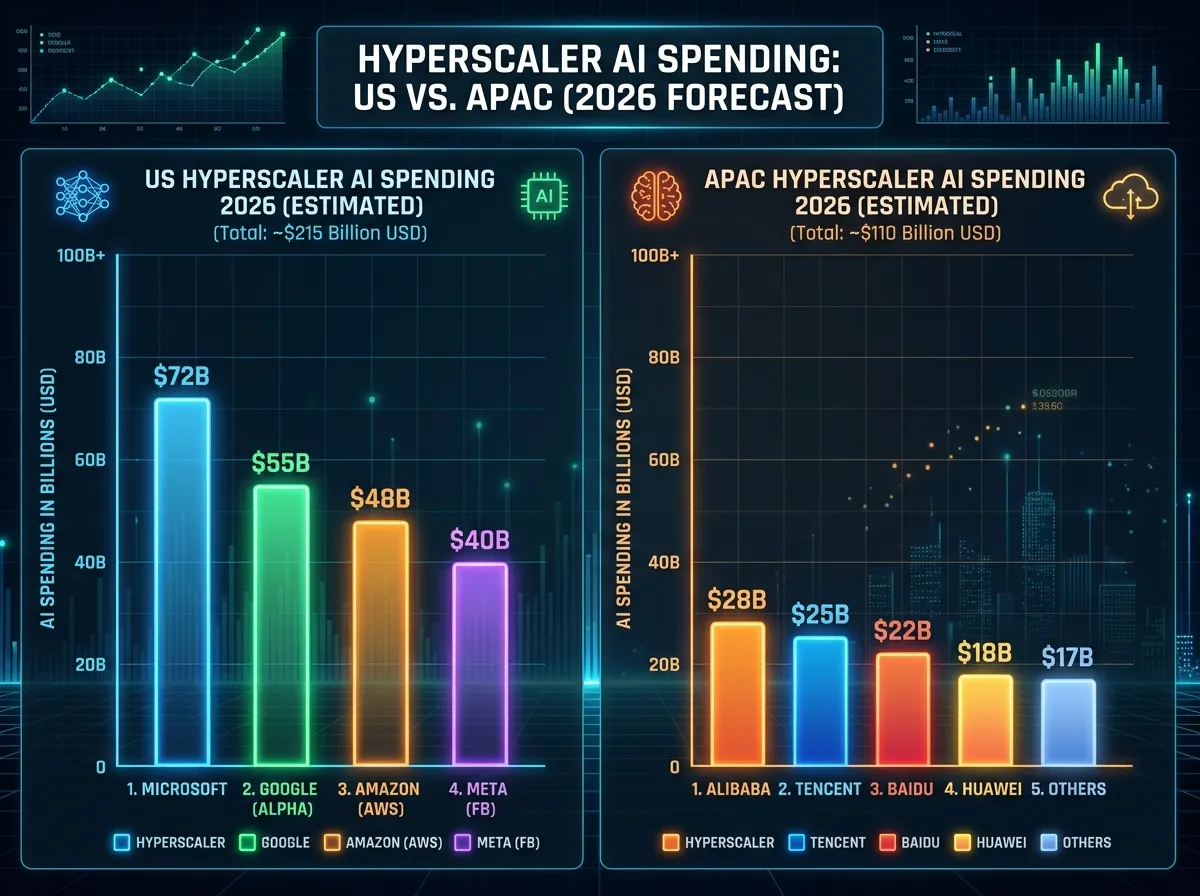
The four largest US hyperscalers, Microsoft, Google, Amazon, and Meta, plan to spend approximately $650 billion on AI infrastructure in 2026 alone. Amazon's capital expenditure exceeded $100 billion in 2025, most of it going to AWS. Europe's total annual AI investment is perhaps 10-15% of what the US spends. The EU has three foundation models. The US has forty.
The semiconductor gap is even more stark. NVIDIA holds roughly 80% of the AI data center accelerator market. There is no European alternative. Every "sovereign" European AI infrastructure runs on NVIDIA GPUs fabricated by TSMC in Taiwan. Former ASML CEO Peter Wennink called the EU's target of reaching 20% global semiconductor production by 2030 "totally unrealistic." The European Court of Auditors projects 11.7%.
Roy Illsley, Chief Analyst at Omdia, offered a mixed verdict: "This is Europe beginning to get their act together, but I do think it may be too little too late as the cloud boat has sailed. However, the AI boat is still in the harbor." His point cuts to the heart of the strategy. Europe may never build a cloud ecosystem to rival AWS. But if it positions itself early in AI governance, sovereign AI infrastructure, and payment systems, it can establish independence in the layers that matter most going forward.
The contradictions are real. France champions EU sovereignty while simultaneously building Bleu, a joint venture between Microsoft, Orange, and Capgemini for sovereign cloud services. Germany is pursuing Delos, another Microsoft partnership with SAP. National bilateral deals with the same companies the EU is trying to reduce dependence on undermine the collective effort. The regulatory burden is considerable: CADA would add to GDPR, the AI Act, the Digital Markets Act, the Digital Services Act, the Data Act, NIS2, and the Cyber Resilience Act. Fifty-five percent of small and medium enterprises already cite regulatory complexity as their greatest challenge.
What This Means
What Europe is attempting has no precedent at this scale. China's tech decoupling from the US was driven by centralized state power and a willingness to accept short-term economic costs. Europe must coordinate 27 member states with competing national interests, navigate an open market that its own treaties require it to maintain, and build alternatives to products that hundreds of millions of Europeans already use daily. Analysts estimate untangling European workloads from US clouds could require two decades.
The ECB's decision to exclude American cloud providers from the digital euro is the clearest signal of where the policy is heading. So is France's 2027 deadline for removing American communications platforms from its government. These are not aspirational statements. They are procurement decisions with contracts attached. Ludovic Francesconi, EPI's Chief Strategy Officer, framed Wero's ambition without hedging: the project is "about completing the architecture of Europe's payment sovereignty with a scalable European alternative."
The question is not whether Europe wants digital independence. The Parliament vote settled that. The question is whether a continent that produces 3 AI foundation models to America's 40, that holds 15% of its own cloud market, and that has no semiconductor fabrication capacity for cutting-edge AI chips can actually build the infrastructure to back up the ambition. The political will is there. The money is starting to arrive. The technology exists, at least for office software and payments. The open question is whether Europe can execute at the speed the moment demands, or whether, as Illsley suggested, the cloud boat has already sailed and the best it can hope for is to be on the next one.
Sources
- Tech.eu: Europe Builds Microsoft-Compatible "Euro-Office" to Reclaim Digital Sovereignty - Euro-Office announcement, Frank Karlitschek and Achim Weiss quotes
- Euronews: How Close Is the EU to Breaking Free From Visa and Mastercard's Grip? - Wero payments system data, ECB Christine Lagarde warning, merchant fee statistics
- The Register: US Cloud Giants Excluded From Digital Euro Project - ECB cloud provider decision, Roy Illsley and Steve Brazier quotes
- Foreign Policy: Europe's Digital Declaration of Independence - Comprehensive overview of tech dependency statistics and Macron-Merz summit
- Computerworld: Europe Votes to Tackle Deep Dependence on US Tech - European Parliament 471-68 vote, Michal Kobosko "digital colony" quote