
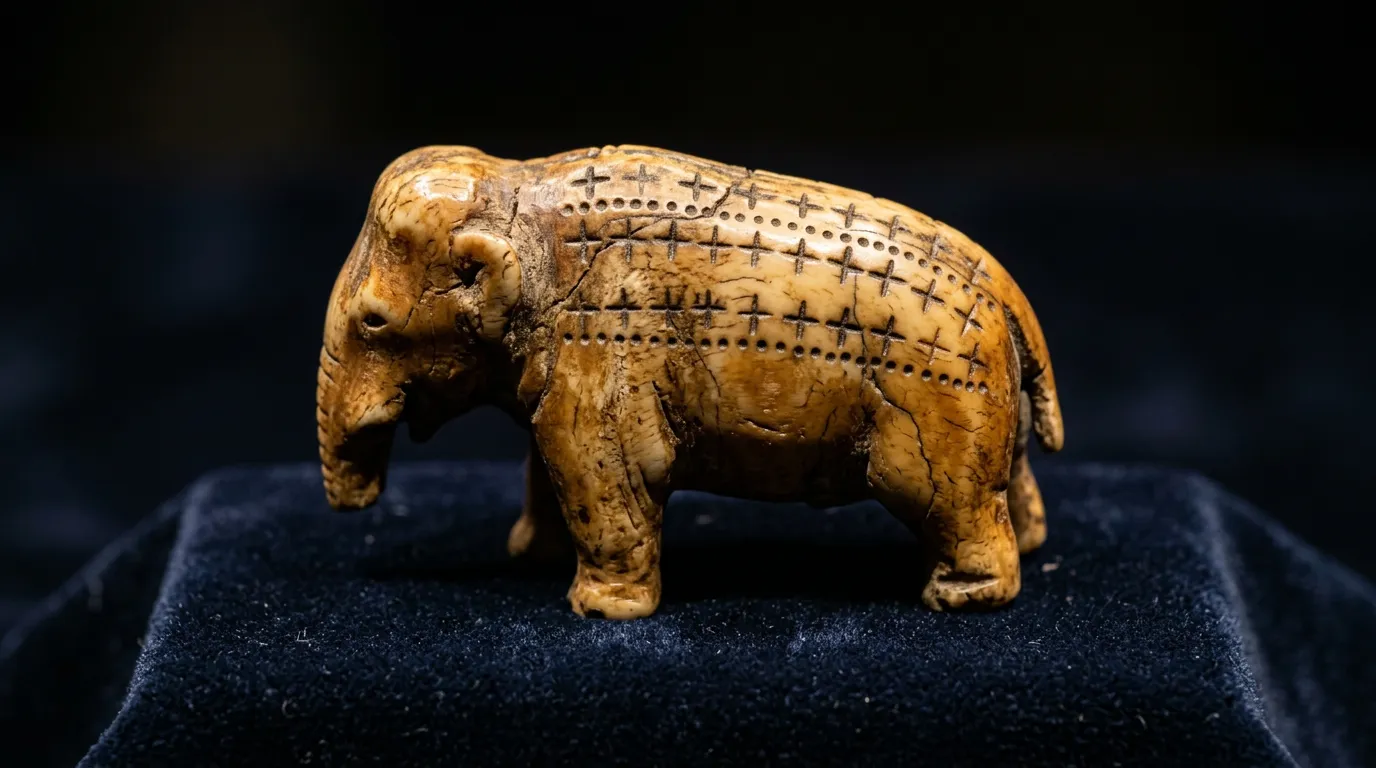
Forty thousand years ago, in a cave in what is now southwestern Germany, someone picked up a small figurine carved from mammoth ivory and began to cut a series of crosses into its surface. The marks were deliberate and evenly spaced, arranged in rows. They were not random scratches or the byproduct of tool sharpening. They followed a pattern, and that pattern had rules. Crosses appeared on animal figurines. Dots did not appear on tools. V-shaped notches were the most common mark across the entire collection of objects. Whoever carved these signs was working within a system, a shared vocabulary of 22 distinct symbols that governed what mark went where and on what kind of object.
That system, according to a February 2026 study published in Proceedings of the National Academy of Sciences, is the oldest known structured sign inventory in the archaeological record. It predates the cave paintings of Lascaux and Chauvet by roughly 10,000 years. It predates proto-cuneiform, the earliest known writing system, by more than 37,000 years. And its information density, measured through computational analysis of entropy rates, rivals that of those first Mesopotamian scripts. The people who carved these marks were not writing in any modern sense of the word. But they were doing something that, until now, no one had demonstrated for this period of human history: they were encoding information in a structured, rule-governed way.
Twenty-Two Symbols from the Swabian Jura
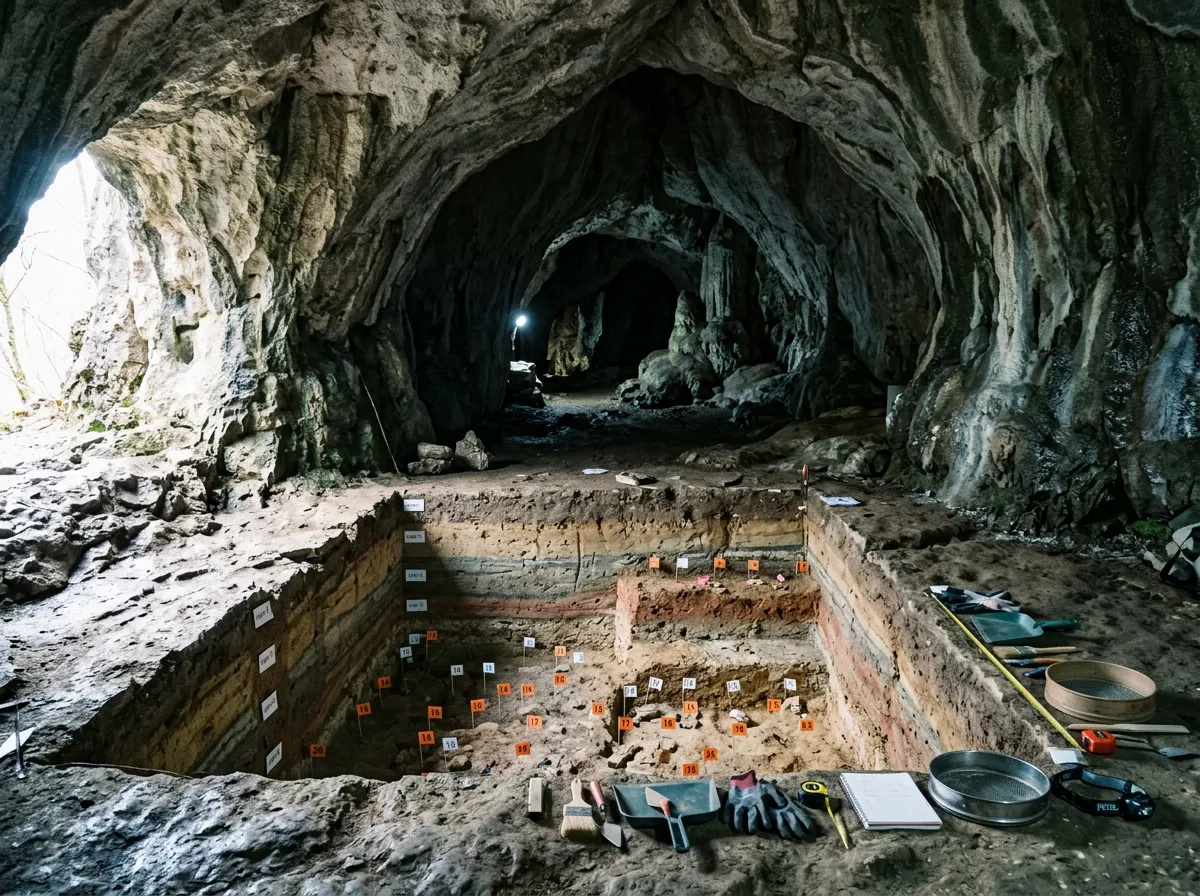
The study, led by linguist Christian Bentz and archaeologist Ewa Dutkiewicz, analyzed over 3,000 intentionally engraved marks across 260 mobile objects from the Aurignacian period. The artifacts were found in caves in the Swabian Jura region of southwestern Germany, a limestone plateau honeycombed with cave systems that have produced some of the oldest known examples of figurative art in the world. Dating of the objects placed them between 34,000 and 45,000 years ago, a window that encompasses the arrival and early settlement of anatomically modern humans in Europe.
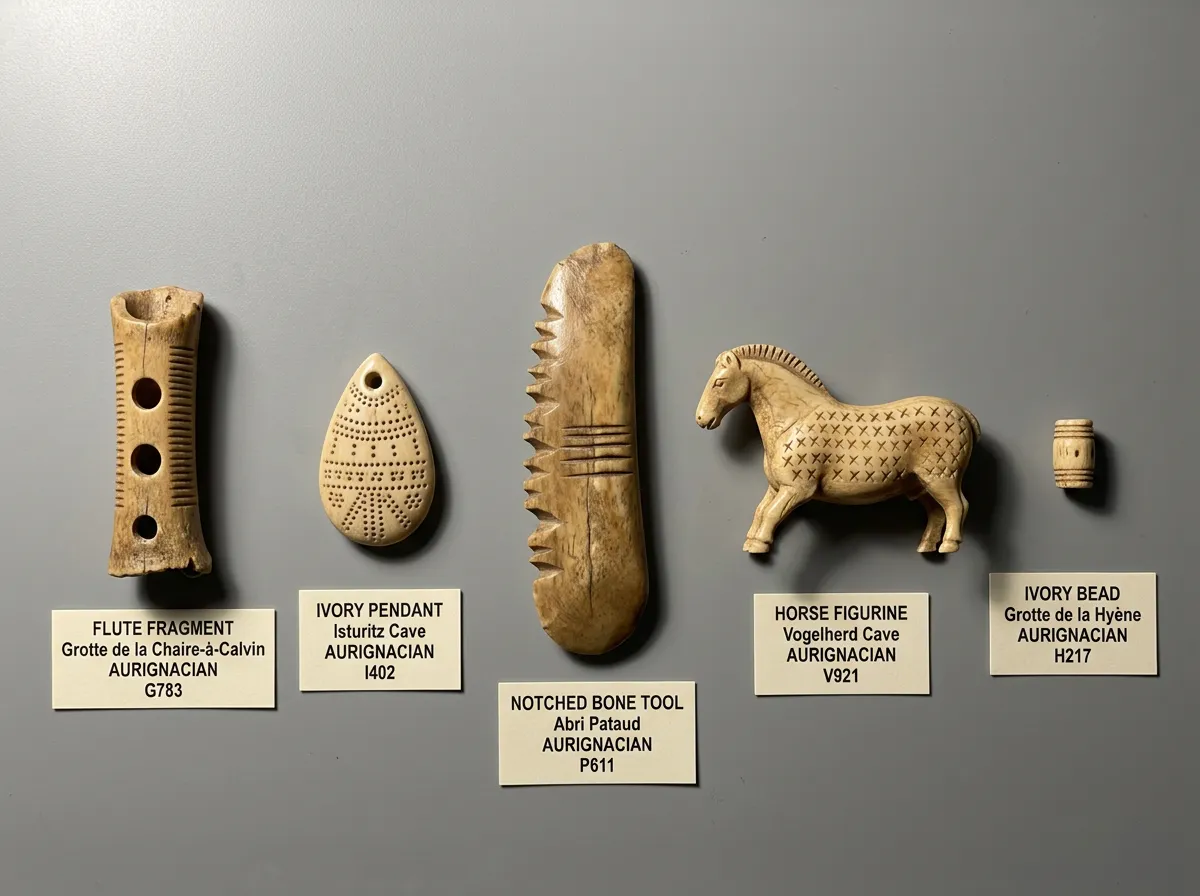
What Bentz and Dutkiewicz found was not a random assortment of scratches. The marks fell into a distinct inventory of 22 different symbol types. V-shaped notches were the most frequent, followed by lines, crosses, and dots. Each symbol type had consistent formal properties across multiple sites and objects, meaning that a cross carved on a figurine at Vogelherd Cave looked like a cross carved on a figurine at Hohle Fels Cave, even though the two sites are kilometers apart. The symbols were not idiosyncratic. They were standardized.
This finding alone would be significant, but the real weight of the study lies in the rules that governed how these symbols were used. Crosses were commonly carved onto animal figurines, particularly representations of horses and mammoths. They never appeared on human figures. Dots, conversely, were found on figurines and certain ornamental objects but never on tools. This selectivity implies that the marks carried meaning related to the type of object they were placed on, not just decorative impulse. If someone in the Aurignacian wanted to mark a stone tool, they used different symbols than if they were marking an ivory horse. That is a rule, and rules imply a shared understanding among the people who followed them.
Measuring Information with Mathematics
Bentz brought a computational method to the analysis that had never before been applied to Aurignacian marks: entropy rate measurement. Entropy rate, in information theory, quantifies the amount of information carried per symbol in a sequence. A completely random sequence of symbols has high entropy but no structure. A sequence where every symbol is identical has low entropy and carries no information at all. Real communication systems fall somewhere in between: structured enough to follow rules, varied enough to carry meaning.
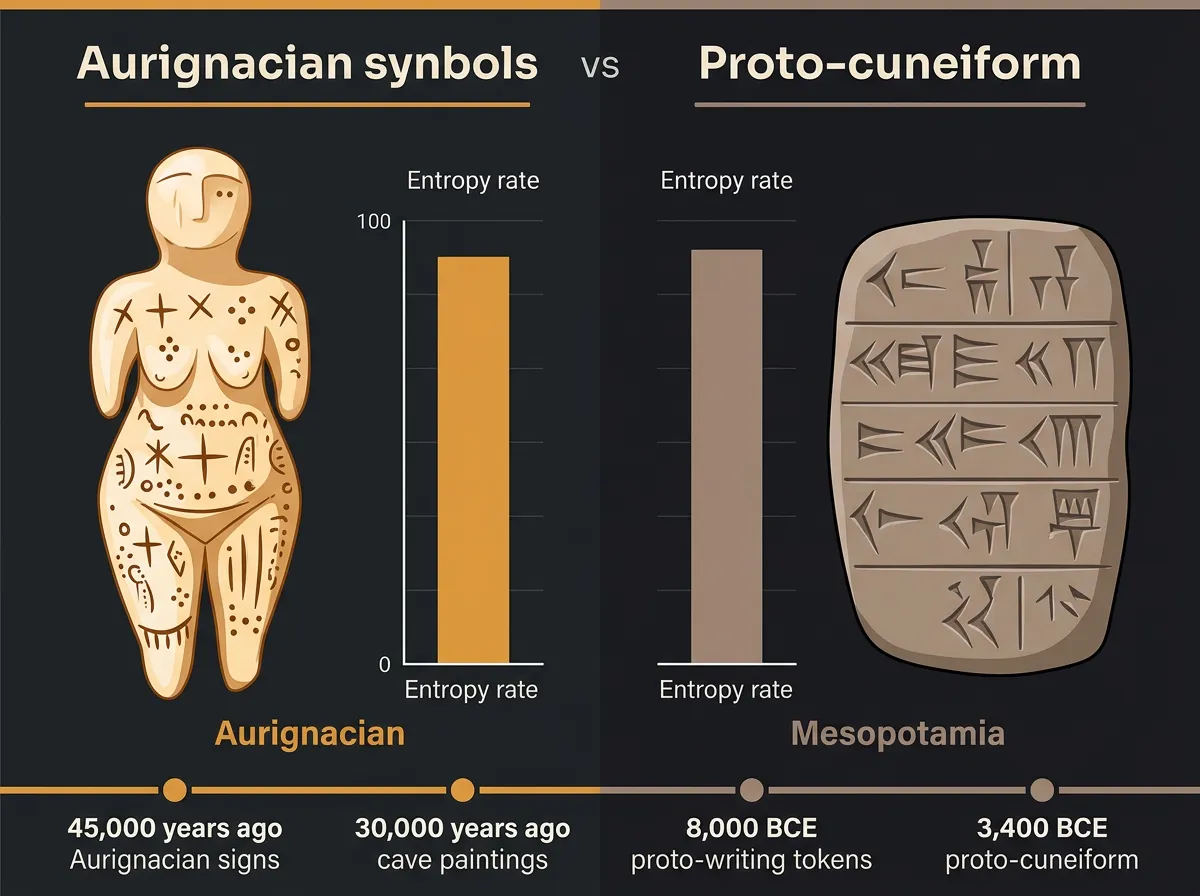
The researchers calculated entropy rates for the symbol sequences on the Aurignacian objects and compared them with known early writing systems. The comparison was striking. The information density of the Aurignacian signs was comparable to that of proto-cuneiform, the script used by Mesopotamian administrators around 3,000 BCE to track grain stores, livestock, and labor. Proto-cuneiform was not a full writing system in the way that later Sumerian cuneiform became, but it was the earliest known system for encoding complex economic information in visible marks. The fact that Ice Age hunters in Germany were producing marks with similar information density 37,000 years earlier forces a reconsideration of what "symbolic communication" means and when it began.
One of the study's most revealing findings concerned where information density was highest. The researchers found that entropy rates were systematically higher on ivory figurines than on tools or flutes. Figurines showed entropy rates 15 to 29% higher than other object categories. This was not a marginal difference. It suggests that when Aurignacian people chose to concentrate symbolic information, they did so on their most symbolically important objects: the carved representations of animals and, more rarely, humans. Tools received simpler marks. Flutes fell somewhere in between. The concentration of complex symbol sequences on figurines implies that these objects carried a communicative or mnemonic load that other objects did not.
A Mammoth Figurine and Its Message
One artifact from the study brings the abstract statistics into focus. A small mammoth figurine from Vogelherd Cave, one of the most famous Aurignacian sites in the Swabian Jura, bears rows of crosses and dots arranged in a deliberate pattern across its surface. The figurine fits in the palm of a hand. It was carved from mammoth ivory with considerable skill, the proportions of the animal rendered accurately enough that the species is immediately recognizable. And someone, perhaps the carver or perhaps a later owner, covered it in symbols.
The crosses on the Vogelherd mammoth follow the general rule observed across the entire dataset: crosses appear on animal figures. But the specific arrangement of crosses and dots on this one object, the spacing, the grouping, the combination of two symbol types, is particular to this figurine. That particularity is exactly what the entropy analysis measured. If the marks were purely decorative, you would expect similar patterns repeated mechanically across objects. Instead, the combinations vary from object to object, each carrying a slightly different sequence. The variation suggests that the marks encoded something specific to each object, perhaps an identity, a story, a tally, or a category that we cannot yet reconstruct.
Christian Bentz, the linguist who co-led the study, has been careful to avoid calling the Aurignacian signs "writing." Writing, in the strict sense used by linguists and archaeologists, involves the encoding of spoken language. These signs almost certainly did not do that. But Bentz argues that the distinction between "writing" and "structured symbolic communication" may matter less than we assume. "What we are seeing is a system that was used consistently across sites and across generations," he told PNAS in a statement accompanying the study. "It was shared, it was rule-governed, and it carried measurable information content. Whether we call that writing or not is partly a question of definition."
Pushing the Timeline Back 10,000 Years
Before this study, the earliest evidence for structured sign systems in the archaeological record came from cave paintings dating to roughly 30,000 years ago. Geometric signs, including dots, lines, and hand stencils, appear in cave art across Europe from the Gravettian period onward. Researchers like Genevieve von Petzinger, a paleoanthropologist at the University of Victoria, have catalogued dozens of recurring geometric signs in European cave art, arguing that they formed a kind of graphic communication system. Von Petzinger's work showed that many of the same symbols appeared in caves thousands of kilometers apart, suggesting that they were part of a shared tradition rather than independent invention.
The Bentz and Dutkiewicz study pushes the timeline back by about 10,000 years and shifts the medium from cave walls to portable objects. The Aurignacian signs are older than the Gravettian cave paintings, and they appear on objects that people carried with them as they moved across Ice Age Europe. This portability is significant. Cave paintings are fixed to their locations. A mammoth figurine with crosses carved into it could travel with its owner, be shown to people at distant camps, and potentially be passed from person to person. The signs on portable objects could circulate in ways that cave paintings could not. They were, in a sense, a mobile communication technology.
The gap between these Aurignacian signs and the next recognized step in symbolic communication is enormous. Proto-writing systems, including tallies and tokens, appear in the archaeological record around 8,000 BCE in the ancient Near East. Proto-cuneiform emerges around 3,400 BCE in Mesopotamia. The conventional timeline of writing's development jumps from Ice Age cave art to Neolithic tokens to Sumerian tablets, with each step separated by thousands of years. The Aurignacian signs fill a gap at the oldest end of that sequence. They show that the cognitive capacity for structured symbolic communication existed tens of thousands of years before anyone needed it for accounting or administration.
What the Signs Were Not
It is worth being explicit about what the study does not claim. Bentz and Dutkiewicz do not argue that the Aurignacian signs were language. They do not propose a decipherment. They do not suggest that the signs could express the range of ideas that even proto-cuneiform could. What they demonstrate is narrower and, in some ways, more interesting: that a population of Ice Age hunters maintained a shared inventory of symbols, applied those symbols according to consistent rules, and concentrated the most complex symbol sequences on their most symbolically charged objects.
This leaves open the question of what the signs meant. The possibilities span a wide range. The marks could have been ownership marks, identifying which figurine belonged to which person or lineage group. They could have been ritual symbols, encoding mythological or spiritual associations tied to particular animals. They could have been mnemonic devices, helping their users remember stories, songs, or practical information associated with the objects. They could have been tallies, counts of hunts, kills, seasons, or trade transactions. Without a larger corpus and without any continuity to later, better-understood sign systems, we cannot determine which of these functions (if any) the signs served.
What we can say is that the marks were not random. The computational analysis rules out chance arrangement. The placement rules (crosses on animals, dots never on tools) rule out pure decoration. The entropy rates rule out the possibility that these were simple repetitive marks like tally sticks or abacus counters. Something more complex was happening, something that required the kind of shared conventions that characterize communication systems across cultures and time periods. The Gravettian toolkit traditions already showed how much organizational sophistication these Ice Age communities possessed. The Swabian Jura signs now add a symbolic dimension to that picture.
Rethinking the Cognitive Timeline
The standard narrative of human cognitive evolution follows a slow upward slope. Anatomically modern humans appear in Africa around 300,000 years ago. Behavioral modernity, defined loosely as the full suite of symbolic, technological, and social capabilities we associate with living humans, emerges gradually over tens of thousands of years. Shell beads in North Africa date to 80,000 years ago. Ochre pigments used for body painting appear around the same time. Figurative art arrives in Europe around 40,000 years ago with the Aurignacian. Writing arrives in Mesopotamia around 5,000 years ago. The progression is tidy, but it may be misleading.
The Swabian Jura signs complicate this narrative because they collapse the distance between figurative art and structured symbolic communication. If the earliest known figurative carvings and the earliest known structured sign system appear in the same caves, on the same objects, at the same time, then the cognitive leap from "making art" to "encoding information in symbols" may not have been a leap at all. It may have been a single, integrated capacity that expressed itself simultaneously in representational carving and symbolic notation.
Ewa Dutkiewicz, the archaeologist who co-led the study, has spent years working with the Swabian Jura collections. She points out that the figurines were never purely aesthetic objects. "These carvings were made to be handled, carried, and shown," she noted. "The marks on them were part of their function, not an afterthought." This observation aligns with the entropy data: if the marks were decorative additions, you would not expect them to carry structured, variable information content. The marks were integral to the objects, and the objects were integral to the social and symbolic lives of the people who made them.
Original Analysis: The Problem of Invisible Systems
Here is something the published study does not address directly but that the data forces us to consider: if a structured sign system existed 40,000 years ago on portable objects, how many other such systems existed and left no trace? The Swabian Jura caves are exceptional preservation environments. The limestone formations created stable, dry conditions that allowed ivory, bone, and antler to survive for tens of thousands of years. In most other environments, organic materials decompose within centuries. If the Aurignacian people carved similar signs into wood, painted them on animal hides, or traced them in sand, those records are gone.
This preservation bias has broad implications. We know from ethnographic studies of recent hunter-gatherer societies that symbolic communication takes many forms, most of them perishable. Australian Aboriginal message sticks are carved from wood. Plains Indian winter counts were painted on buffalo hides. Andean khipu used knotted cords to encode complex information. If any of these systems had been invented 40,000 years ago, virtually none of them would survive in the archaeological record. The Swabian Jura signs survive because ivory is extraordinarily durable and because the people who made them happened to live in caves with favorable preservation conditions. That makes the signs a window, not a wall. They tell us what one group did in one region. They cannot tell us what was happening across the rest of the inhabited world at the same time.
The entropy rate comparison with proto-cuneiform is particularly provocative in this context. Proto-cuneiform was a specialized administrative tool that arose in the specific economic conditions of early Mesopotamian city-states. The Aurignacian signs arose in the entirely different context of mobile hunter-gatherer bands navigating Ice Age Europe. The fact that both systems produced similar information density per symbol, despite serving completely different social functions in completely different societies separated by 37,000 years, suggests that there may be a cognitive floor to structured symbolic communication: a minimum level of complexity that any such system naturally reaches once a community commits to maintaining one. If true, then the capacity for writing-like symbol systems may be far older and far more widespread than the archaeological record can ever directly show. The phantom islands of early cartography remind us how much of what earlier humans knew and communicated has been lost or misunderstood by later generations. The Aurignacian signs are a rare case where the original marks survived long enough for us to measure what they actually contained.
The Deeper Question
What the Swabian Jura study ultimately challenges is the assumption that structured symbolic communication required the pressures of agriculture, trade, and urbanization to emerge. The traditional story of writing's invention is an economic one: people developed writing because they needed to track grain, debts, and labor in societies too large for memory alone. That story is true for Mesopotamia. But the Aurignacian signs suggest that the impulse to encode information in structured symbols did not wait for grain surpluses or city walls. It appeared, fully formed in its basic cognitive structure, among small bands of hunters who carved crosses into mammoth ivory by firelight in German caves.
We will probably never know what those crosses meant to the people who carved them. The content is lost. But the structure is not. The 22 symbols, their placement rules, their concentration on figurines, and their measurable information density tell us that the human capacity for writing did not emerge suddenly in Mesopotamia 5,000 years ago. It had been developing, in forms we are only now learning to recognize, for at least 40,000 years. Writing, in this expanded sense, is not a late invention. It is one of the oldest things about us.
Sources
- Christian Bentz and Ewa Dutkiewicz, "Structured sign systems on Aurignacian mobile objects from the Swabian Jura," Proceedings of the National Academy of Sciences, February 2026
- Genevieve von Petzinger, The First Signs: Unlocking the Mysteries of the World's Oldest Symbols, Atria Books, 2016
- Nicholas J. Conard, "A female figurine from the basal Aurignacian of Hohle Fels Cave in southwestern Germany," Nature, Vol. 459, 2009
- Harold Dibble et al., "New excavations at the site of Vogelherd Cave," Journal of Human Evolution, 2017