
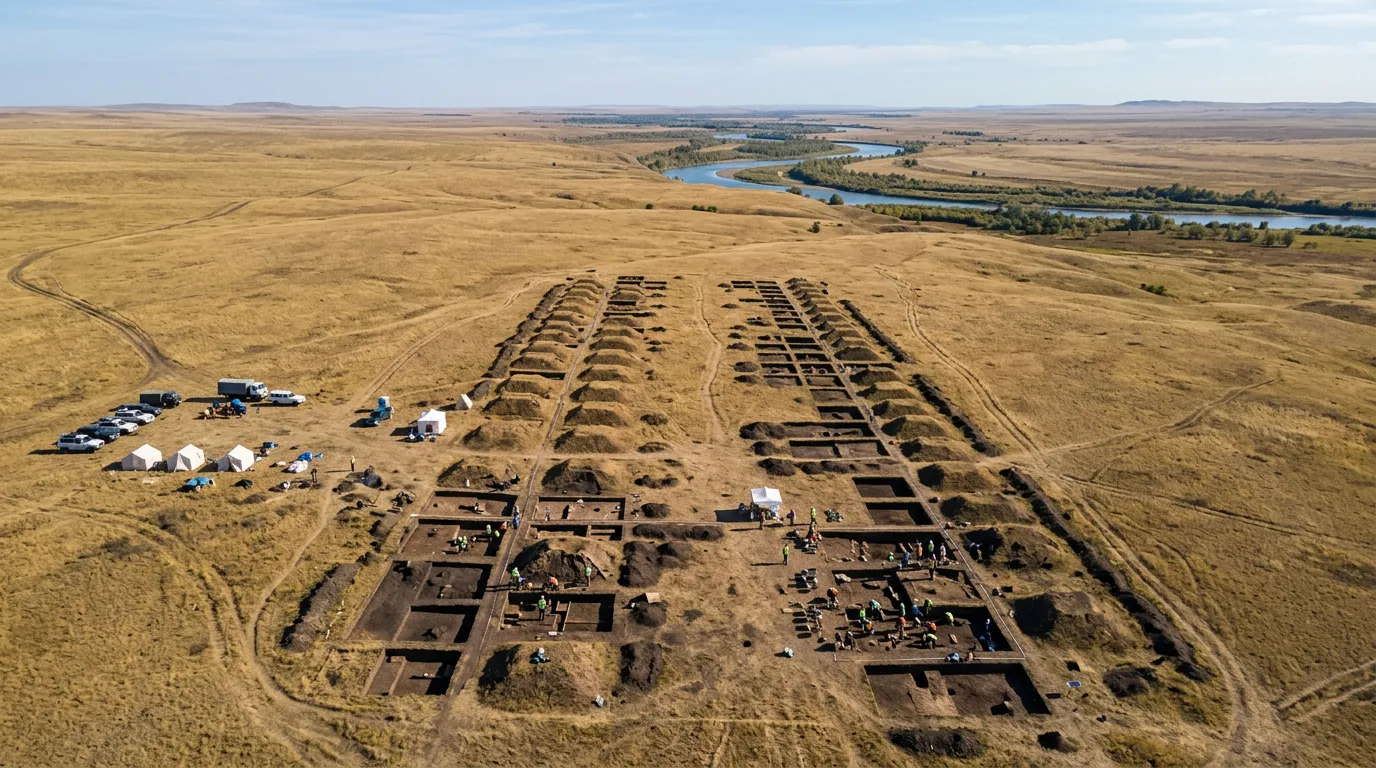
The Eurasian steppe has always been shorthand for emptiness. In the popular imagination, and in much of the archaeological literature, the vast grasslands stretching from Hungary to Mongolia belonged to nomads: horse riders, herders, people who moved with the seasons and left little behind. Cities were what settled civilizations built, in Mesopotamia, along the Nile, in the Indus Valley. The steppe was where people passed through. A UCL-led research team has just demonstrated how wrong that assumption was. Their survey of a site called Semiyarka, published in the journal Antiquity, reveals a 140-hectare Bronze Age settlement in northeastern Kazakhstan that dates to approximately 1600 BC. It is the largest ancient settlement ever documented in the region, and its existence forces a fundamental reconsideration of what Bronze Age steppe societies were capable of building.
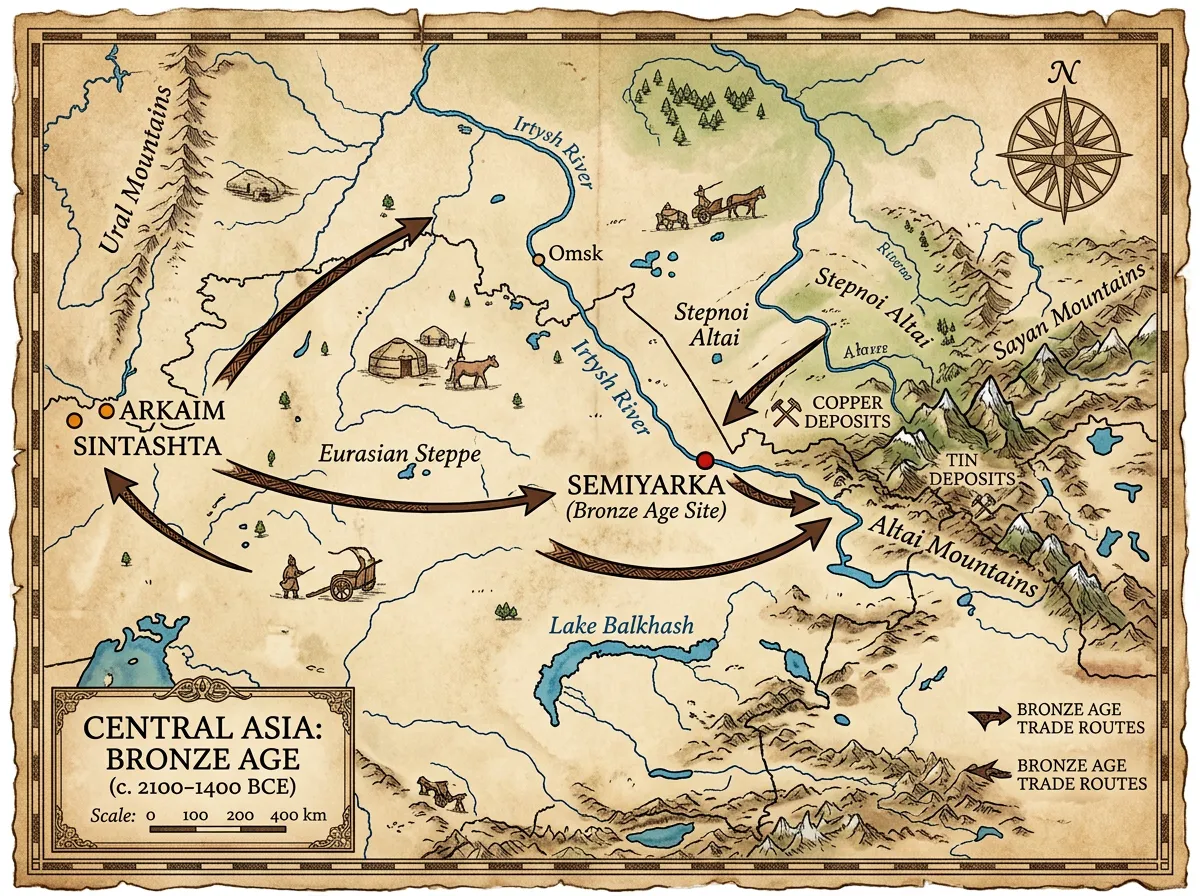
Semiyarka, nicknamed the "City of Seven Ravines" for its position above a network of seven valleys, sits on a promontory overlooking the Irtysh River. That location was not accidental. The Irtysh provided water, transportation, and control over passage below. More importantly, the site lies close to the copper and tin-rich Altai Mountains, the raw materials necessary for bronze production. More than 3,500 years ago, Semiyarka was likely one of the most important industrial hubs in this part of Eurasia, a place where metallurgists turned raw ore into the alloy that defined their age.
What the Ground Reveals
The archaeological survey combined surface examination with geophysical scanning, a technique that maps subsurface structures without digging. What emerged was a settlement far more organized than anyone expected. Two long rows of rectangular earthen mounds, each about a meter high, once formed the foundations of enclosed houses with multiple rooms. These were not temporary shelters or seasonal camps. They were permanent structures, arranged in deliberate patterns that suggest centralized planning.
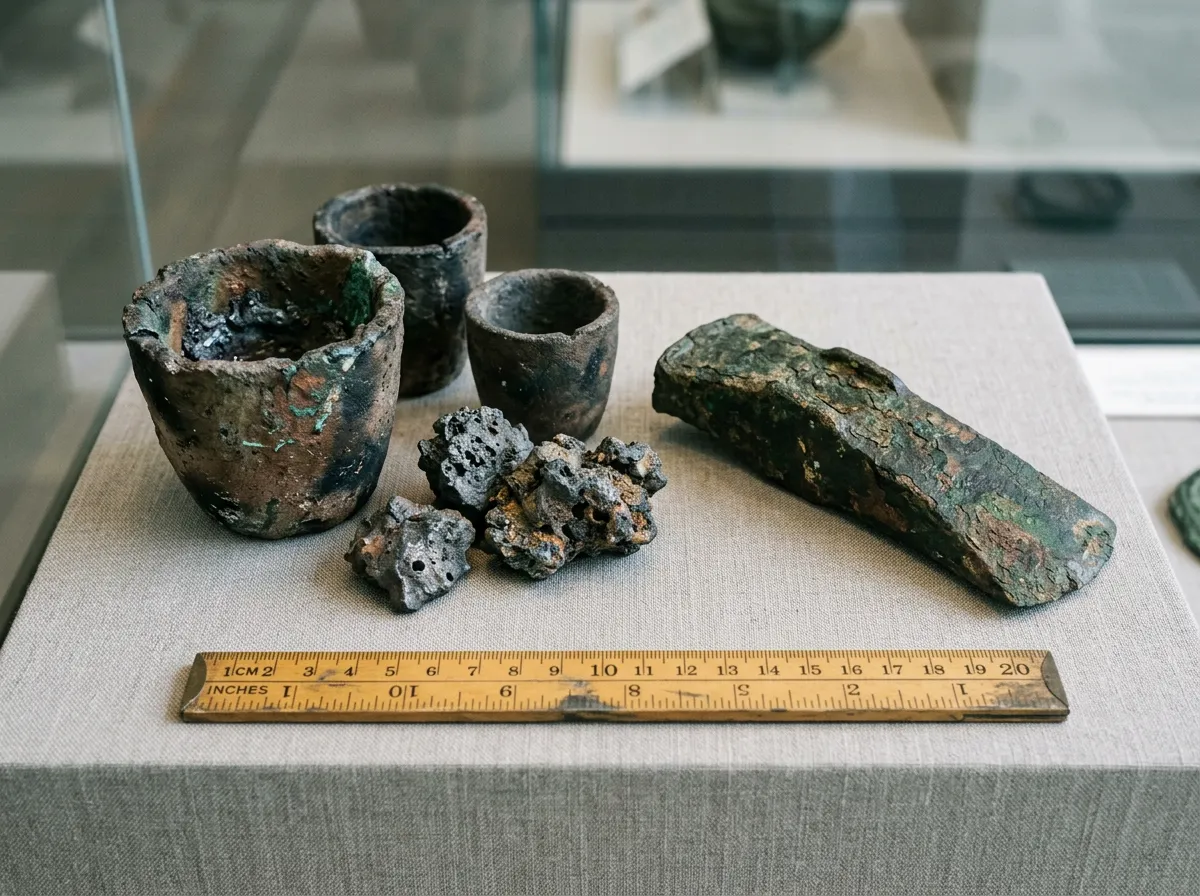
Near the residential rows, archaeologists identified the remains of a much larger central building, roughly twice the size of the surrounding homes. Its function is not yet certain, but the scale suggests it served an administrative, communal, or ritual purpose. The building's position at the heart of the settlement mirrors a pattern seen in other Bronze Age urban centers, where a central structure anchored the civic life of the community. Crucibles, slag, and tin bronze artifacts recovered from the site confirm that Semiyarka was not merely a residential settlement. It was a production center, a place where metallurgists operated complex systems that transformed raw materials from the nearby mountains into finished bronze goods.
Why Archaeologists Didn't Expect a City Here
The conventional model of Bronze Age steppe life centers on the Andronovo cultural complex, a loosely connected set of communities that occupied the Eurasian grasslands from roughly 2000 to 900 BC. Andronovo people practiced mixed economies: some agriculture, some pastoralism, some metallurgy. But the standard picture described these communities as small, scattered, and semi-mobile. They built modest settlements of 10 to 30 houses, engaged in local trade, and produced bronze tools for regional consumption. The idea that they might have constructed anything approaching urban scale was not seriously considered.
Semiyarka's 140 hectares shatter that picture. For comparison, the famous Bronze Age site of Arkaim, often called the "Russian Stonehenge" and located roughly 1,200 kilometers to the west, covers about 20,000 square meters. Sintashta, another well-known Andronovo-era site associated with early chariot technology, is similarly compact. Semiyarka is not just larger than these sites. It is an order of magnitude larger, suggesting a population and organizational complexity that existing models of steppe society simply did not account for.
The discovery also complicates the long-standing dichotomy between "nomadic" and "settled" civilizations. For centuries, historians and archaeologists organized ancient societies along this divide. Cities belonged to the civilizations that built them: Sumerians, Egyptians, Harappans, Chinese. Steppe peoples were categorized as their opposite, mobile societies that relied on horses and livestock rather than fixed infrastructure. Semiyarka suggests this binary was always too simple. The people who lived here were not nomads who occasionally stopped to make bronze. They were builders of a planned settlement with specialized production zones, residential districts, and civic architecture, all organized around the industrial exploitation of nearby mineral resources.
The Bronze Production System
The metallurgical evidence from Semiyarka is what elevates the site from interesting to transformative. Earlier steppe sites have yielded evidence of metalworking, but typically on a small scale: individual workshops producing tools and weapons for local use. Semiyarka's crucibles, slag deposits, and finished artifacts point to something qualitatively different. Metallurgists here were running complex production systems, not scattered workshops, processing copper and tin from the Altai Mountains into bronze goods at a scale that implies distribution networks extending well beyond the settlement itself.
This matters because bronze production in the ancient world was never simple. Unlike copper, which can be smelted from relatively common ores, bronze requires tin, a metal that is geologically rare and unevenly distributed. In the ancient Near East, the scarcity of tin drove long-distance trade networks connecting Mesopotamia to sources in Afghanistan, Cornwall, and the Iberian Peninsula. The same dynamic likely operated on the steppe. Semiyarka's proximity to tin sources in the Altai Mountains would have given it a strategic advantage, making the settlement a natural hub for producing and distributing bronze across a vast trading area.
The centralized production model also implies social complexity that goes beyond what small-scale pastoralist communities typically develop. Large-scale metallurgy requires organized labor, resource management, and trade relationships with communities that supply raw materials and consume finished products. The ancient city of Alexandria on the Tigris demonstrated similar principles in a later period, where control over trade routes and resource extraction determined which settlements grew into regional powers. Semiyarka appears to have followed the same logic 1,200 years earlier, on grasslands rather than river valleys.
The Steppe as a Place, Not a Passage
For most of recorded history, the steppe has been described in terms of what moved across it. The Scythians rode through on horseback. The Mongols swept west in the 13th century. The Silk Road carried goods between China and Rome. In each of these narratives, the steppe is a backdrop, a space between civilizations rather than a civilization in its own right. Semiyarka challenges that framing by presenting evidence of a settled, organized, industrially productive community that existed on the steppe during the same centuries that Hittites were building an empire in Anatolia and Shang Dynasty rulers were consolidating power in northern China.
The implications extend beyond a single site. If Semiyarka existed as a 140-hectare urban center in 1600 BC, it is reasonable to ask what else the steppe might be hiding. Geophysical survey techniques, the same technology that revealed Semiyarka's subsurface structures, have only been applied to a small fraction of the Eurasian grasslands. The region is enormous, spanning roughly 8,000 kilometers from east to west, and archaeological investigation has been concentrated in a handful of well-known sites. The UCL team's work suggests that the "empty steppe" narrative may be less a reflection of ancient reality than a product of where archaeologists have and have not looked.
This echoes a broader pattern in archaeology. For decades, the assumption that complex societies required river valleys and fertile agricultural land directed research toward those environments. The Ice Age sign system discovered across European cave sites demonstrated that cognitive sophistication predated settled civilization by tens of thousands of years. Semiyarka makes a parallel argument: that organizational sophistication on the steppe predated the arrival of historically documented empires by millennia, and that the apparent absence of cities was a gap in our knowledge, not a fact about the past.
What Remains Unknown
Semiyarka raises as many questions as it answers. The site has been surveyed, not fully excavated, meaning that the residential structures, the central building, and the metallurgical workshops have been identified through geophysical methods but not yet dug up and studied in detail. Full excavation would likely reveal artifacts, residues, and architectural details that could clarify how the settlement was governed, what its inhabitants ate, and how they related to neighboring communities.
The question of Semiyarka's relationship to the broader Andronovo complex is particularly important. Was this settlement unique, an anomaly produced by unusually favorable geography and resource access? Or does it represent a class of large steppe settlements that have gone undetected because no one was looking for them? If the latter, the Andronovo period would need to be reconceptualized not as a collection of small pastoralist communities with occasional metalworking but as a network of settlements varying dramatically in size, function, and complexity, with places like Semiyarka serving as regional production and trade hubs.
The timeline also raises questions. Semiyarka dates to approximately 1600 BC, placing it in the middle Bronze Age. By this period, the steppe had already been inhabited by metallurgical communities for several centuries. Did Semiyarka grow gradually from a smaller settlement, accumulating population and infrastructure as its bronze production expanded? Or was it founded deliberately as a planned industrial center, the way colonial-era mining towns were established near resource deposits? The answer would tell us something fundamental about how steppe societies made decisions about where and how to build.
The Bigger Picture
Semiyarka is one site, incompletely excavated, in a region that spans a continent. Drawing sweeping conclusions from a single discovery is risky. But the site's scale, organization, and metallurgical infrastructure cannot be accommodated by existing models of Bronze Age steppe life. Something was happening on the Kazakh steppe 3,500 years ago that our histories have not accounted for: the construction of a planned settlement with industrial capacity, civic architecture, and a population that may have numbered in the thousands, all in a landscape that historians have long described as home to nothing but grass and horses.
What Semiyarka ultimately demonstrates is the cost of assumptions. When archaeologists assumed the steppe was empty, they did not look for cities. When they did not look, they did not find them. The UCL team looked, and they found a 140-hectare Bronze Age settlement hiding in plain sight. The question now is not whether Semiyarka is real. The evidence is clear. The question is how many more sites like it are waiting beneath the grass.
Sources
- Sophisticated Bronze Age city unearthed in Kazakhstan transforms our understanding of steppe societies - Live Science
- City of Seven Ravines: Bronze Age metropolis unearthed in the Eurasian steppe - Phys.org
- Archaeologists uncover ancient Bronze Age city in Central Asia - Durham University
- A massive Bronze Age city hidden for 3,500 years just surfaced - ScienceDaily