
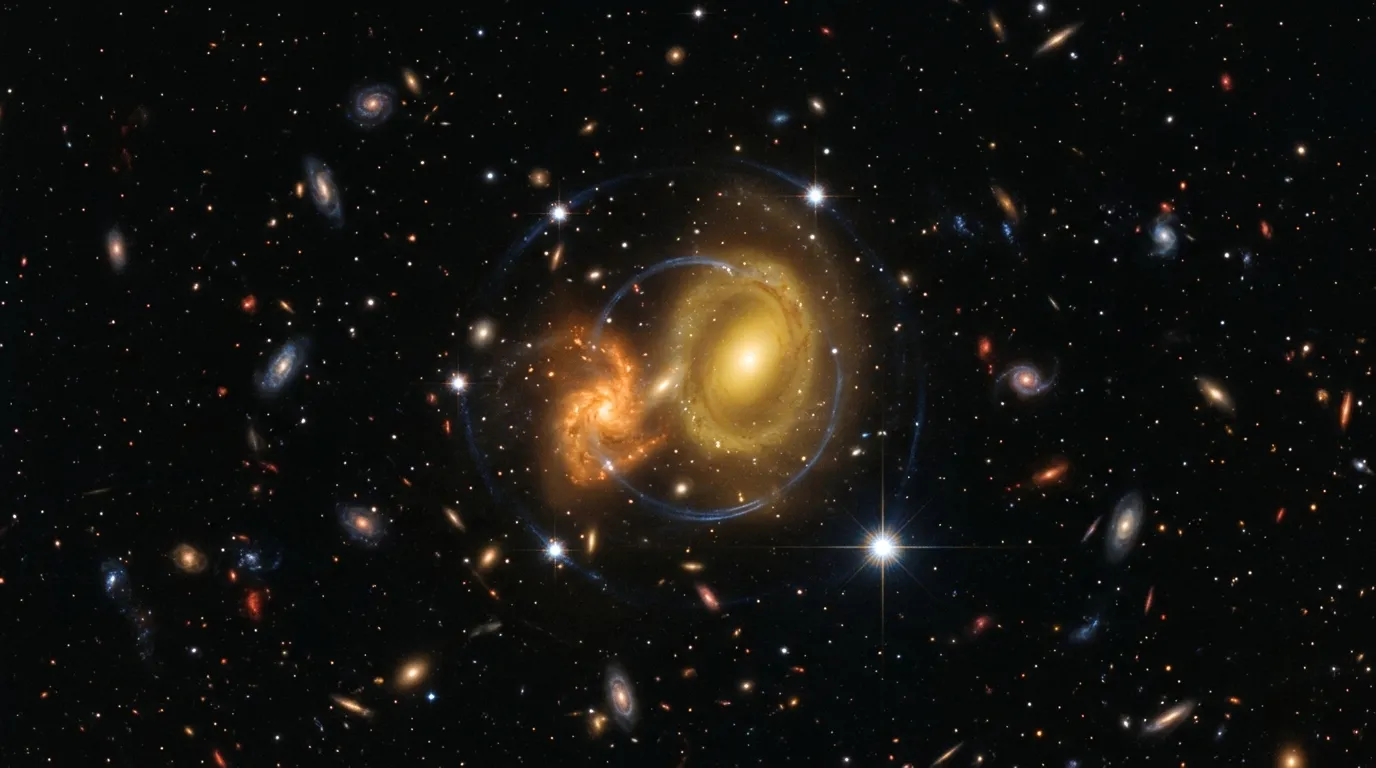
In August 2025, a research team at the Technical University of Munich crossed a name off a six-year-old list. Among hundreds of gravitational lenses they had been quietly monitoring, one had finally produced what they were waiting for: a superluminous supernova, ten billion light-years away, sitting precisely behind a system of foreground galaxies that bent its light into five separate copies. The odds of any single lens delivering this configuration are lower than one in a million. The odds of finding it within a working career are why the team had built such a long list.
The supernova's official designation is SN 2025wny. The team calls it SN Winny. And what makes Winny worth six years of patience is not its brightness or its distance but its geometry. By measuring the slight differences in arrival time between its five images, astronomers can compute one of the most contested numbers in physics: the rate at which the universe is currently expanding, the Hubble constant.
That number has split cosmology in two. The expansion rate the universe seems to have today does not match the expansion rate predicted from the universe's youth. The mismatch is small, only about nine percent, but it has not gone away after a decade of better measurements, and at five-sigma confidence it is well past the threshold where physicists say a problem is real. Either something is wrong with our measurements or something is wrong with our model of the cosmos. SN Winny offers a third option: a clean, independent way to find out.
The Same Explosion, Five Times Over
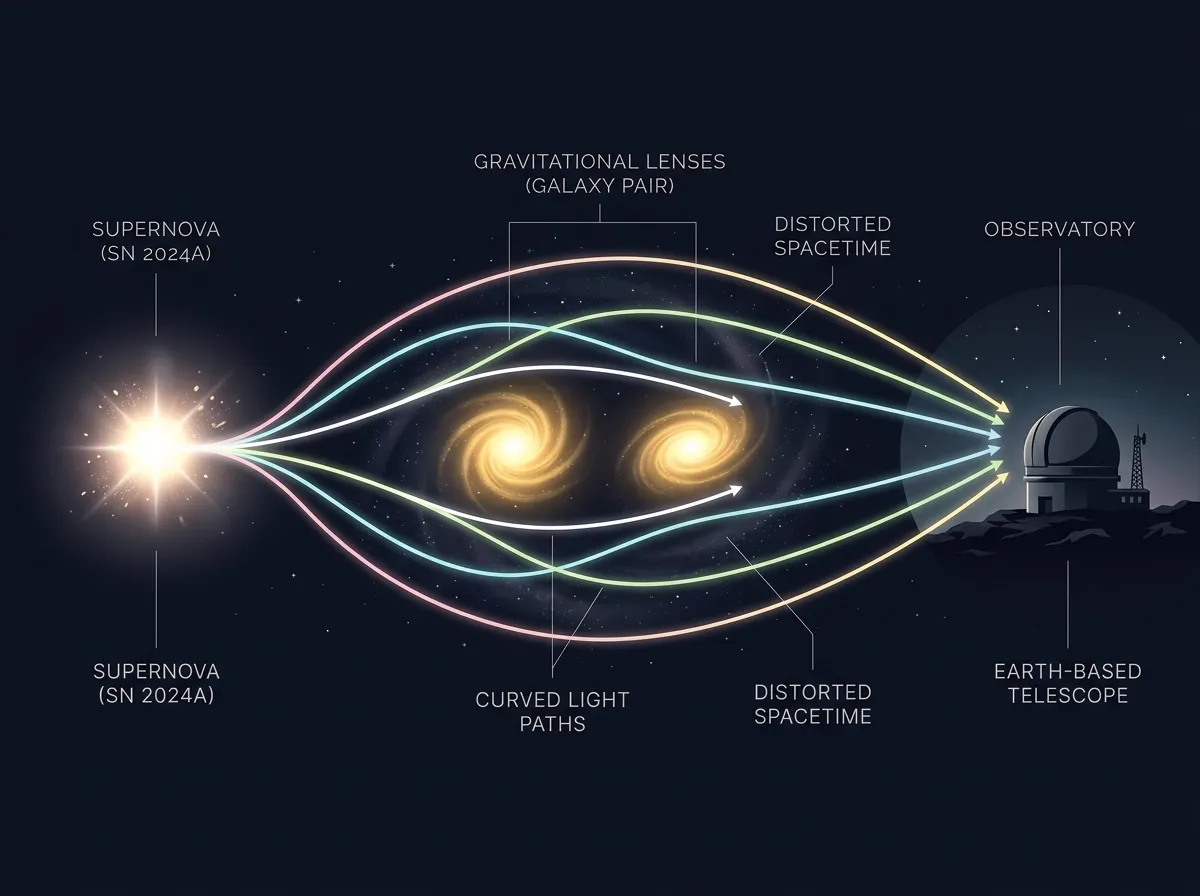
The first thing to understand about Winny is that there is only one supernova. The five points of light arriving at telescopes in Arizona and Hawaii are five different paths the same explosion's photons took on their way to Earth. Each path threads around two foreground galaxies that sit between us and the source, and each path has a slightly different length. Light moves at a fixed speed, so a longer path means a later arrival. The light from one image of Winny has been traveling for hundreds of days longer than the light from another, and the gap between them is what cosmologists actually want.
Sherry Suyu, an associate professor of observational cosmology at TUM and a fellow at the Max Planck Institute for Astrophysics, leads the team that found it. The Large Binocular Telescope in Arizona, with its twin 8.4-meter mirrors and adaptive optics correcting for atmospheric blurring, produced the first high-resolution color image showing all five copies clearly. "The chance of finding a superluminous supernova perfectly aligned with a suitable gravitational lens is lower than one in a million," Suyu told reporters. The geometry the team got was not just rare but unusually clean: the bending masses are well-separated, the lens model is tractable, and the supernova is bright enough to track for many months before its light fades.
Winny is also what astronomers call a superluminous supernova. These are roughly ten to a hundred times brighter than ordinary Type Ia or core-collapse explosions, which gives the team something they desperately need: a long, well-sampled light curve. The brighter and longer-lived the source, the more confidently the team can pin down the moment each image peaks, and the smaller the uncertainty on the time delay between them.
Two Numbers That Refuse to Agree
To see why a single well-aligned supernova matters this much, you have to understand the fight it is walking into. There are two ways to measure how fast the universe is expanding right now, and they keep giving different answers.
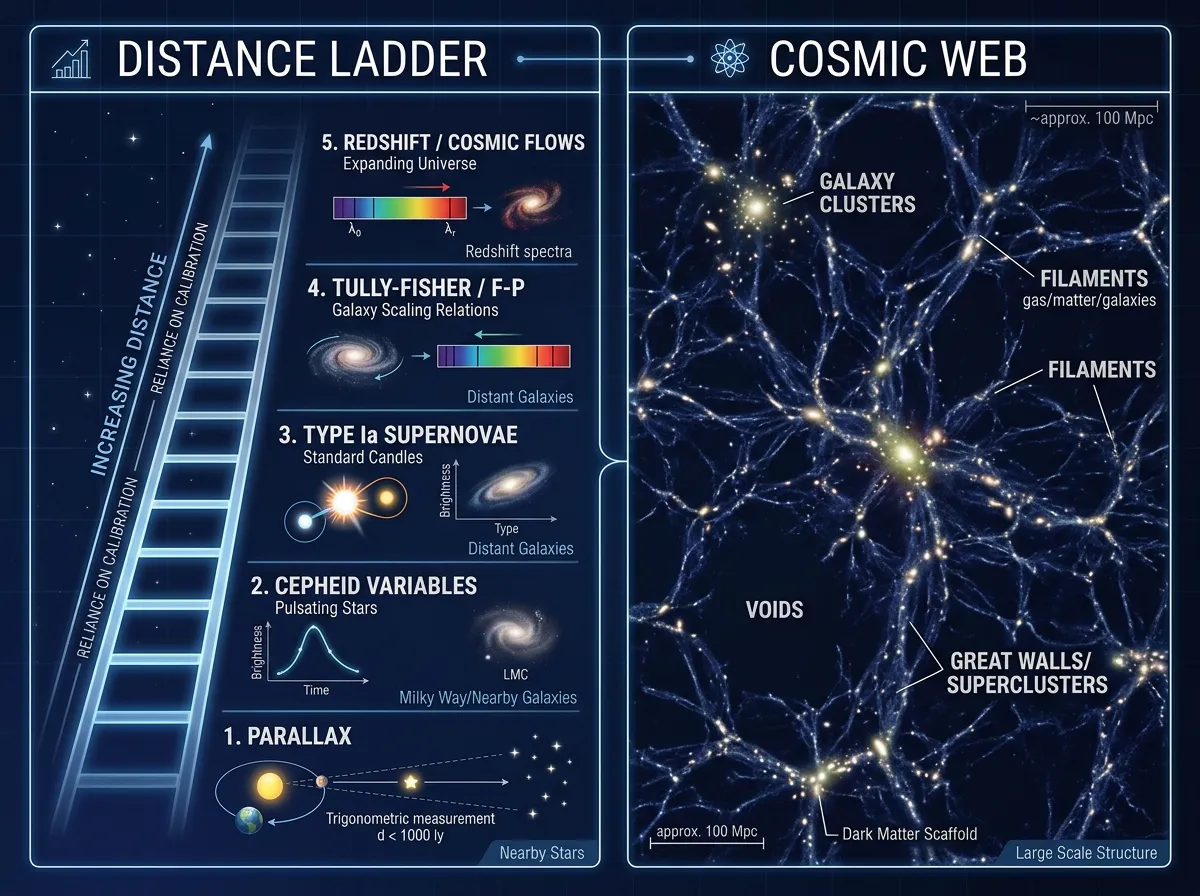
The first method walks outward. Astronomers calibrate distances to nearby objects, then use those to calibrate distances to slightly farther objects, then those to ones farther still, and so on. By the time the ladder reaches galaxies far enough that cosmic expansion dominates their motion, you can compare a distance to a redshift and read off the Hubble constant directly. The leading distance-ladder team, called SH0ES and led by Adam Riess, has spent years tightening this measurement. In 2022 they reported H0 = 73.04 ± 1.04 kilometers per second per megaparsec, using roughly three hundred high-redshift Type Ia supernovae anchored to Cepheid variable stars.
The second method works backward. The cosmic microwave background, the faint radio glow left over from when the universe became transparent some 380,000 years after the Big Bang, encodes precise information about the early universe's geometry, density, and composition. Plug the Planck satellite's measurements into the standard Lambda-CDM cosmological model, evolve it forward 13.8 billion years, and the model predicts today's expansion rate should be H0 = 67.4 ± 0.5. The two values disagree by about five-sigma. In particle physics that level of disagreement is what counts as discovery. In cosmology it is what counts as a crisis.
Both teams have spent the last decade trying to find the systematic error that would close the gap, and neither has found one big enough. The Cepheid calibrations have been tested against red giants, against the tip of the red giant branch, against masers; the early-universe analysis has been redone with different recombination codes and different priors. The numbers move a little. They never converge.
Refsdal's 1964 Idea, Finally Catching Up
The lensing time-delay method was not invented for the Hubble tension. It was invented sixty-two years before there was a tension to solve. In 1964, the Norwegian astrophysicist Sjur Refsdal published a paper in Monthly Notices of the Royal Astronomical Society showing that if a supernova ever appeared behind a strong gravitational lens, you could read the Hubble constant directly off the time delays between its images. The idea is geometrically clean: bigger universe means longer paths means longer delays, and the relation between path length difference and expansion rate falls out of the math without needing a distance ladder.
For half a century the proposal sat unrealized, because the kind of lensed supernova Refsdal needed simply had not been observed. Then in November 2014, a graduate student named Patrick Kelly noticed four points of light arranged in an Einstein cross around a galaxy in the cluster MACS J1149.5+2223, in a Hubble Space Telescope image. They were images of a single supernova, and the cluster's mass models predicted the explosion would reappear in a fifth image about a year later. It did, in December 2015, in roughly the predicted spot. The supernova was named SN Refsdal in honor of the man who had described the experiment in writing decades before any instrument could perform it.
SN Refsdal returned a Hubble constant near 64 km/s/Mpc, on the early-universe side of the tension but with uncertainties large enough that it could not arbitrate. The team called it a proof of concept and said the field needed more lensed supernovae, ideally brighter and in cleaner geometries. SN Winny is what they have been waiting for.
Why Time Delays Become a Yardstick
The reason this method matters so much is that it does not lean on the assumptions the other two methods lean on. The distance ladder rests on the calibration of standard candles and the homogeneity of Type Ia supernovae across cosmic time. The CMB analysis rests on the Lambda-CDM model being correct in detail, including assumptions about dark energy, neutrino masses, and recombination physics. Both have been worked on for decades, and the residual systematic uncertainties tend to be the kind that move the answer by a few percent, which is exactly the size of the tension itself.
A lensed-supernova measurement leans on different things. It leans on a model of the gravitational potential of the foreground galaxies, on accurate photometry of the time-varying images, and on the geometry of the lens system. The systematic risks are real but they are uncorrelated with the systematics of the other methods. As Allan Schweinfurth, a junior researcher on the TUM team, put it: "The overall simplicity of the system offers an exciting opportunity to measure the Universe's expansion rate with high accuracy."
That uncorrelation is the whole point. If SN Winny lands at 73, the early-universe model has a problem. If it lands at 67, the late-universe distance ladder has a calibration error somewhere. If it lands somewhere in between with small enough errors, the tension itself has to be reconsidered. Cosmology does not need yet another measurement of the Hubble constant; it needs a measurement that disagrees with one of the existing ones for a reason that cannot be hand-waved away.
What Six Years of Hunting Looked Like
Finding SN Winny was not luck. It was the payoff of a long, deliberate search the TUM and Max Planck team built around a simple insight: if lensed supernovae are rare, then to find one in a usable amount of time you have to be watching a lot of lenses at once. Beginning in 2019, the team compiled a catalog of strong gravitational lenses already known from Hubble, ground-based surveys, and dedicated lens-finding programs. They cross-referenced these with regular cadence imaging from telescopes that could monitor large patches of sky on a weekly to monthly basis, building software pipelines that would flag any new transient appearing inside a known lens system.
The work was unglamorous. Most candidates turned out to be foreground stars, distant active galactic nuclei, or noise. The team published intermediate results, refined their lens catalogs, and waited. The discovery of SN Winny in August 2025 came through their HOLISMOKES program, an international collaboration dedicated to finding lensed supernovae. The supernova flagged itself in routine monitoring data. The alignment with one of the team's pre-identified lenses was confirmed within days.
That kind of patient, infrastructural science is increasingly the dominant mode in cosmology. The era when one heroic observation could settle a question is mostly over; the questions that remain are the ones that require waiting for rare events to happen, and being prepared to recognize them when they do. The Vera C. Rubin Observatory, beginning its decade-long Legacy Survey of Space and Time, is expected to find dozens to hundreds of lensed supernovae over its operational life, joining the next generation of survey instruments that are reshaping how astronomers study transient cosmic events. Winny is the proof that the strategy works while the new instruments come online.
What a Resolved Tension Would Buy Cosmology
If SN Winny and the lensed supernovae that follow it confirm one of the existing measurements decisively, what changes? The honest answer is that it depends which one wins, and either outcome is interesting.
If the local measurement of 73 holds and the early-universe prediction of 67 turns out to need revision, that almost certainly means our model of the early universe is incomplete. The candidate fixes are not subtle: extra relativistic species, a brief burst of "early dark energy" in the first few hundred thousand years, modifications to the way recombination happened, or a non-standard expansion history before the CMB was emitted. Each of these would represent the first concrete extension to the Lambda-CDM model since dark energy was identified in the late 1990s, and each would imply that the very early universe contains physics we have not yet measured.
If the early-universe value of 67 holds and the local distance ladder turns out to have a hidden calibration problem, the implication is less dramatic but equally important: it would mean the supernova-based measurements that are currently used for everything from dark energy constraints to galaxy evolution carry a systematic shift that needs to be applied across decades of published results. Many cosmology results that depend on the absolute distance scale would need to be quietly recomputed, and the constraints on dark energy's behavior over time would change with them.
There is also a less satisfying possibility, which working cosmologists privately discuss the most: the answer is in between, the tension softens rather than resolves, and the field gets a slow erosion of the disagreement rather than a single breakthrough measurement. Whether SN Winny is sharp enough on its own to deliver a clean verdict will not be clear until the team measures all five time delays and publishes a Hubble constant with full systematics. The first set of papers, accepted in Astronomy, lays out the system; the actual H0 result will come later, after the longest delay between images plays out.
What Has To Happen Next
The five images of SN Winny will not all peak at the same time. The whole experiment depends on the team continuing to monitor the system as the lagging images appear, fade, and reveal their delays in days or weeks rather than minutes. That observation campaign is now underway and will run for months. Telescope time has been allocated, follow-up spectroscopy is scheduled, and the TUM team is racing the supernova's natural fade against the calendar of available facilities.
In parallel, the lens model has to be refined. Time delays alone are not enough; converting them into a Hubble constant requires a precise three-dimensional model of how mass is distributed in the two foreground galaxies, including their dark matter halos. That work involves deep imaging of the lens, spectroscopy of the lensing galaxies' velocity profiles, and careful modeling of any subhalos that might perturb the light paths. Each of these steps introduces its own uncertainty, and the final H0 result will only be as clean as the weakest link.
Sjur Refsdal died in 2009, six years before the supernova bearing his name appeared as four images in a Hubble field, eleven years before the 2020 lensed-quasar measurements began nibbling at the Hubble tension, and seventeen years before SN Winny crossed his colleagues' detection threshold. The experiment he described in 1964 has now been performed twice, with one more in active observation, and the question is no longer whether the method works. The question is whether, by the time the Rubin Observatory finishes its first full survey, cosmology will have enough lensed supernovae to settle a fight that the rest of the field cannot finish on its own.
Sources
- ScienceDaily: A one-in-a-million supernova seen five times could reveal the Universe's true speed
- Phys.org: How fast is the universe expanding? Supernova could provide the answer
- Universe Today: Astronomers Devise a New Way to Measure Cosmic Expansion with Lensed Supernovae
- NASA: The Hubble Constant and Tension
- CERN Courier: The Hubble tension
- Refsdal, S. (1964). On the possibility of determining Hubble's parameter and the masses of galaxies from the gravitational lens effect. *MNRAS* 128, 307