
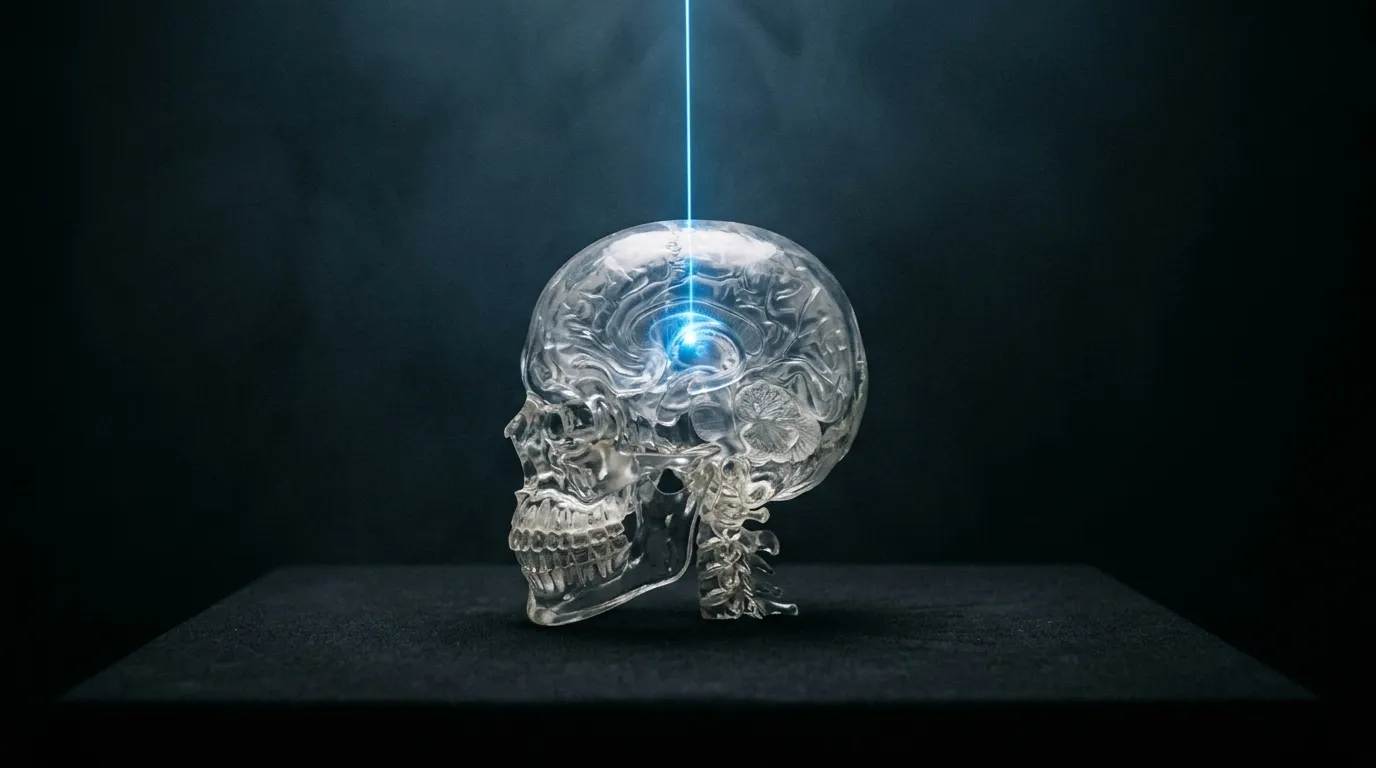
The hardest problem in science is not quite as hard if you are allowed to cheat. For sixty years, anyone trying to figure out where consciousness lives in the brain has had essentially one kind of experiment available: wait for nature to provide a damaged patient, or sit a healthy volunteer in a scanner and correlate brain activity with what they report seeing. Correlation is not causation. You can watch the neurons in the back of the visual cortex light up when someone sees a face, but you cannot prove those neurons are producing the seeing. Maybe they are just keeping the lights on for something else that is.
On January 12, 2026, four researchers from MIT Lincoln Laboratory, MIT's Department of Philosophy and Linguistics, the University of Florida, and Harvard Medical School published a paper that is not itself a new experiment. It is a 40-page road map for the experiments the field actually needs, using a tool that can, for the first time, intervene deep inside a living healthy human brain at millimeter resolution. The tool is a sound wave.
Why Correlation Kept Breaking the Field
The standard equipment of consciousness science has been fMRI, EEG, and MEG. All three are good at telling you what is happening in the brain while someone is conscious. None of them can be reversed. You cannot use an fMRI to turn a piece of cortex off and then ask whether the subject still sees faces. You can only watch and guess.
That limit mattered because for most of the field's modern history, two big theories have been in direct contradiction. The Global Neuronal Workspace view, associated most closely with Stanislas Dehaene at the Collège de France, says consciousness requires a broad broadcast of information across the brain, with the prefrontal cortex acting as a kind of switchboard. Integrated Information Theory, developed by Giulio Tononi at the University of Wisconsin, says consciousness is a property of any system whose internal connections are dense enough, and that the hot zone in humans is the back of the brain, not the front. Both theories generate specific, falsifiable predictions. For thirty years, none of those predictions could be cleanly tested.
The Cogitate Consortium, a multi-lab adversarial collaboration whose results appeared in Nature in May 2025, tried to force the issue by running the same experiments on 256 subjects across three labs using fMRI, MEG, and intracranial EEG. Protocols were agreed in advance by the theories' own proponents, so neither side could move the goalposts after the data was in. When the results arrived, they were not clean. Integrated Information Theory failed a test that predicted sustained synchronization inside the posterior cortex. Global Workspace Theory failed a prediction about prefrontal "ignition" when a conscious perception ended. Both theories lost something. Neither was killed. The field moved a millimeter.
Why Sound Is Different
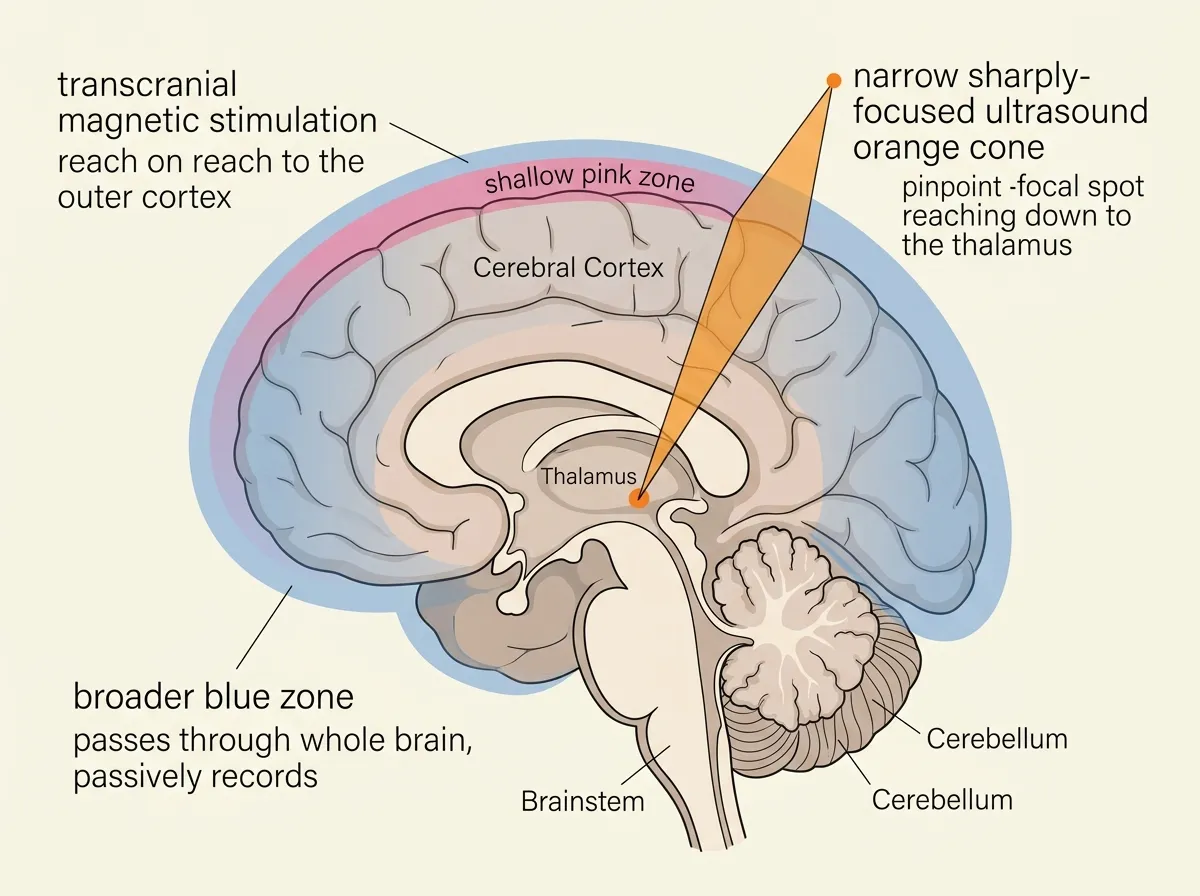
The new paper, "Transcranial focused ultrasound for identifying the neural substrate of conscious perception," published in Neuroscience and Biobehavioral Reviews, argues that the deadlock is a tools problem. If you cannot intervene, you cannot separate correlates from causes. The tool the authors want the field to adopt is not new in medicine. Focused ultrasound has been used for years to ablate uterine fibroids, treat essential tremor, and open the blood-brain barrier for drug delivery in Alzheimer's trials. What is new is using it at energies low enough to modulate neural activity without damaging tissue, and with focus tight enough to reach structures that magnetic and electric stimulation cannot.
"Transcranial focused ultrasound will let you stimulate different parts of the brain in healthy subjects, in ways you just couldn't before," said Daniel Freeman, the Lincoln Laboratory technical staff member who is the paper's lead author. He added a claim in the MIT announcement that is striking coming from an engineer: "It truly is the first time in history that one can modulate activity deep in the brain, centimeters from the scalp, examining subcortical structures with high spatial resolution."
Transcranial magnetic stimulation, the next best non-invasive method, can reach perhaps three centimeters into the cortex with a resolution of roughly a centimeter. It is also pulsed, which limits how long an effect can be held. Focused ultrasound can reach six centimeters in, down to the thalamus, superior colliculus, and brainstem. It can be aimed at a region a millimeter or two across. It can be held on a target for seconds or minutes. If the tool's safety profile holds up, and a growing body of human trials suggests it does, the range of questions it can ask is an order of magnitude larger than what the field had before.
The Experiment That Would Settle It
The paper's authors, including the philosopher Matthias Michel in MIT's Department of Philosophy and Linguistics, are explicit about what they are trying to do. The cognitivist family of theories, which includes Global Workspace, predicts that you can disrupt conscious perception by intervening in the prefrontal cortex. The non-cognitivist family, which includes Integrated Information Theory and local recurrent theories, predicts that prefrontal disruption should leave perception mostly intact, and that posterior intervention should be the thing that disrupts it.
"There are very few reliable ways of manipulating brain activity that are safe but also work," Michel said in the MIT announcement. Without that, the field has been stuck interpreting what the brain is doing rather than testing why it is doing it.
The proposed protocol is almost suspiciously simple. Ask a subject to report what they see. While they are reporting, briefly modulate their posterior cortex with focused ultrasound. Does the report change? If yes, the posterior cortex is causally involved. Repeat with the prefrontal cortex. If prefrontal intervention does not change the report, the prefrontal story loses a lot of its weight.
This is the experiment the field has wanted to run for thirty years. It is also the experiment it has been unable to run.
Why the Back of the Cortex Is the First Target
The authors are clear that the visual cortex is the right first target, for reasons as much practical as philosophical. Vision is the most extensively mapped sensory system in the human brain. The retinotopic organization of the primary visual cortex means that experimenters can predict, to within a few millimeters, where a given stimulus should be represented. If ultrasound disruption at that location changes what the subject reports seeing, the causal link between that cortex and the conscious percept is made.
If it does not, something more subtle is happening, and the theories that tie conscious perception to posterior activity have a new problem. In either case, the experiment is decisive in a way that twenty years of correlational imaging has not been.
A second wave of experiments then moves backward. Subcortical structures, especially the pulvinar nucleus and claustrum, have been implicated in consciousness by patient work. Francis Crick and Christof Koch identified the claustrum in a 2005 paper as a possible "conductor" of conscious experience, coordinating activity across the cortex. Until focused ultrasound, nobody could test that claim in a living, healthy brain at millimeter scale. Now they can.
The pattern of a sharper tool changing what a well-studied region means is familiar in brain science. Earlier this month, a team at UCSF showed that a single protein, FTL1, could be used to partially reverse cognitive aging. A few weeks before, a group at Johns Hopkins identified a previously unmapped drainage pathway in a bone of the skull that anatomy textbooks had described for a century. The generalization writes itself. A thing the field assumed it already understood looks different when something sharper is pointed at it.
The Philosophers Are Back in the Room
One of the quiet features of the MIT roadmap is that a philosopher is a co-author on an engineering paper published in a neuroscience journal. Michel's presence is not decorative. The cognitivist vs. non-cognitivist distinction the paper hinges on is an argument in philosophy of mind that long predates the neuroscience. It goes back at least to Kant, was sharpened in the twentieth century by Ned Block's distinction between "access" and "phenomenal" consciousness, and is about whether the reports people give about their experiences are the experiences themselves, or whether the experiences come first and are cognized only afterward.
The experiment, if it works, will not answer that question in full. It will, however, put hard constraints on it. If prefrontal disruption leaves conscious perception intact, the pure cognitivist view becomes much harder to defend. If it does not, the pure non-cognitivist view has a harder time.
This is the same move that settled, eventually, the nature of memory and the nature of attention. A carefully designed intervention, rather than a cleaner model, forced the field to choose. What counted as a theory of memory in the 1970s is different from what counts today because the tools caught up. The MIT roadmap is a bet that consciousness is the next problem on the list.
What Is Not Yet Resolved
Focused ultrasound is not a finished tool. The mechanism by which it modulates neurons, still under active debate, is thought to involve mechanical deformation of ion channels in the cell membrane. That mechanism works for excitation, for inhibition, and in some cases for both at once depending on parameters. The field has not yet standardized which frequencies, pulse patterns, and intensities produce which effects. Two labs using nominally the same protocol can get opposite outcomes. Seung-Schik Yoo at Harvard Medical School and Brigham and Women's Hospital, one of the paper's authors and the person most associated with early human ultrasound neuromodulation, has been explicit that the field needs a shared parameter catalog before ultrasound can function as the precision instrument for neuroscience that it could become.
The other unresolved question is ethical. Manipulating conscious experience in a healthy volunteer is not the same as asking them to do a cognitive task. Institutional review boards, which have decades of experience with fMRI and years with transcranial magnetic stimulation, are still working out what informed consent looks like in a study designed to, for a few seconds, suppress a particular kind of subjective experience.
A related ethical pressure sits just behind the experimental pressure. If the experiments work, they will produce tools and parameter sets that also apply to clinical interventions in disorders of consciousness, including persistent vegetative state and minimally conscious state. A generative adversarial AI framework published in Nature Neuroscience in early 2026 already identified high-frequency stimulation of the subthalamic nucleus as a promising intervention for some of those patients, and focused ultrasound is the most plausible non-invasive delivery method. Basic science and clinical application are going to be closer in this field than they have been in almost any other.
The Deeper Question
Consciousness research has, for most of its existence, been a field that could describe but could not touch. You could measure activity. You could model it. You could correlate it with reports. You could not, in any clean sense, intervene. That constraint shaped the theories the field was able to produce: each of them was a story about how the brain works, designed to be consistent with data that correlational methods could collect, and not much else.
A tool that intervenes changes the kind of story the field can tell. It makes some theories testable that were not before. It makes other theories harder to shelter than they were. And it makes the philosopher-authored question the Cogitate Consortium could not quite resolve, answerable at last: is the thing we call experience something the brain broadcasts across itself, or is it something one patch of tissue produces, with the broadcast arriving later?
The experiments the MIT roadmap proposes will not answer that in a single publication. They will, over the next decade, produce the kind of evidence that forces one of the two camps to rebuild from the ground up. That is a slower kind of revolution than the press releases usually promise. It is also, historically, the only kind that sticks. Even astronauts returning from low Earth orbit, asked to describe the shift in perception triggered by seeing the whole planet at once, can only gesture at what changed inside them. A sound wave, tightly focused, might be the first tool sharp enough to say where inside them the gesture is pointing.
Francis Crick, writing in 1994, argued that consciousness would be the last biology problem solved, because every other biology problem could be settled by finding the right molecule to intervene with. Consciousness, he suspected, would be settled by finding the right patch of tissue. A focused beam of sound might be what finally lets the field look.
Sources
- MIT News: This new tool could tell us how consciousness works
- Neuroscience and Biobehavioral Reviews: Transcranial focused ultrasound for identifying the neural substrate of conscious perception
- Nature (Cogitate Consortium, 2025): Adversarial testing of global neuronal workspace and integrated information theories of consciousness
- Technology Networks: Mapping Consciousness with Transcranial Focused Ultrasound
- Nature Neuroscience (2026): Adversarial AI reveals mechanisms and treatments for disorders of consciousness