Every rock tells a story, but most of Earth’s stories have been erased. The planet recycles itself constantly, dragging old crust into the mantle and creating new rock at mid-ocean ridges. Tectonic plates collide, mountains rise and erode, and the geological record gets overwritten like a palimpsest that never stops being scraped clean. Most of Earth’s original surface has been destroyed and remade dozens of times over.
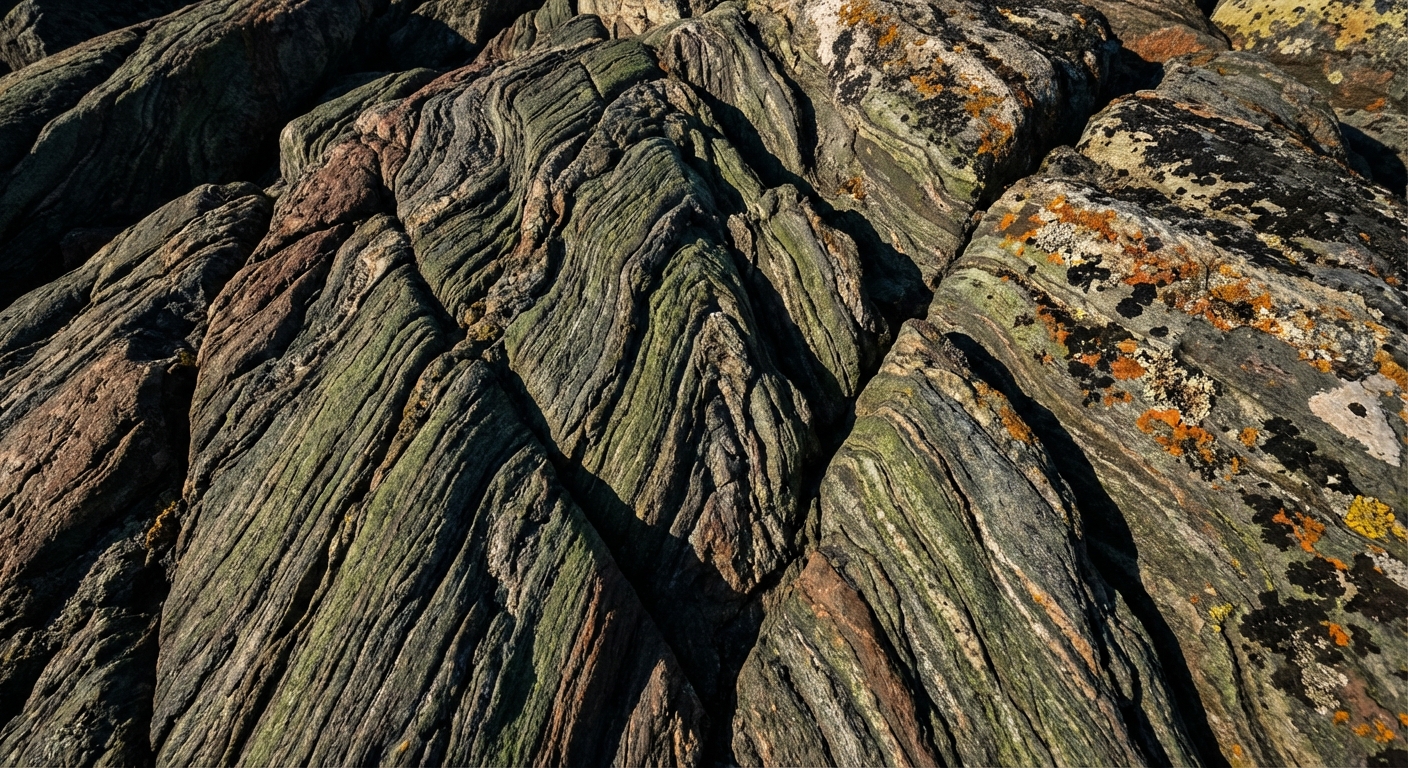
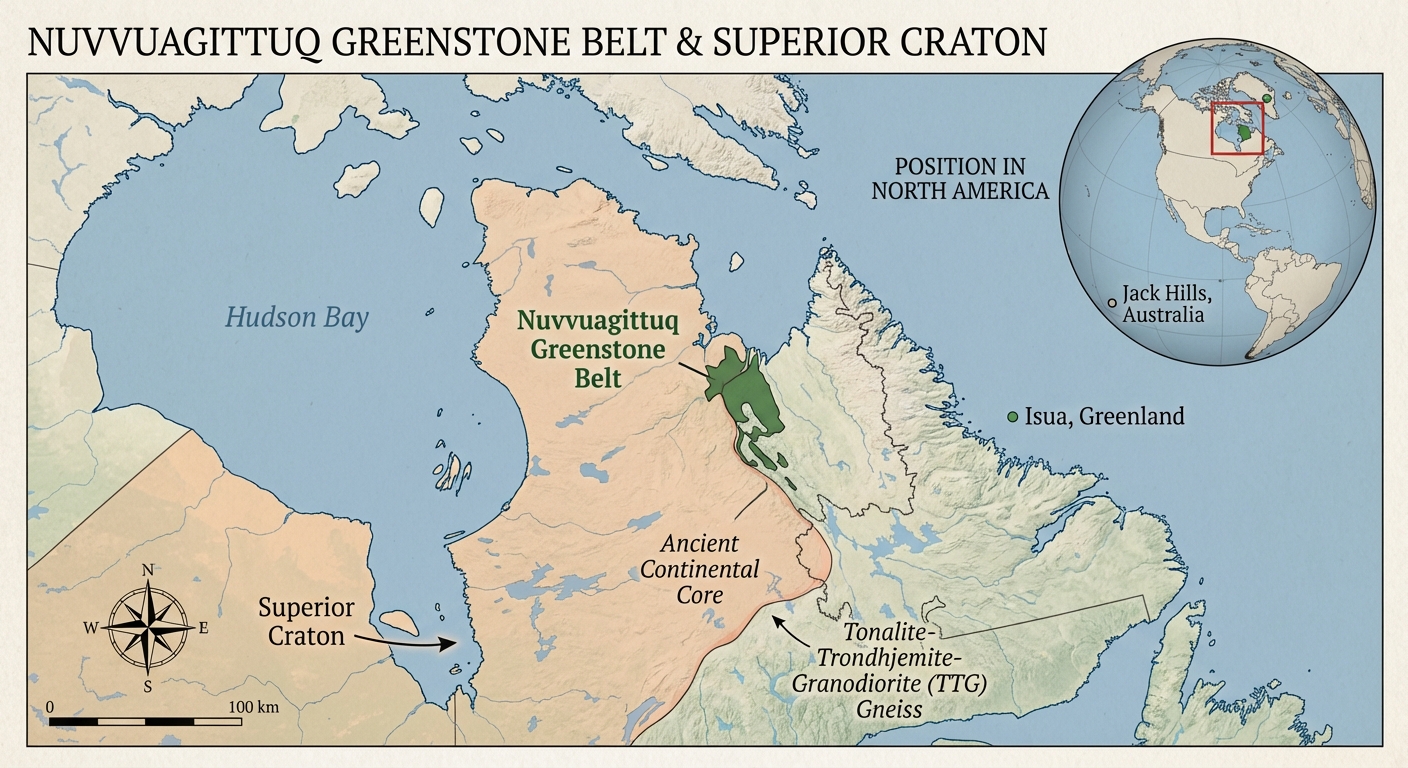
But in a remote corner of northern Quebec, on the eastern shore of Hudson Bay, a small outcrop of rock has somehow survived. The Nuvvuagittuq greenstone belt dates to 4.16 billion years ago, making it the oldest known rock on Earth’s surface. These formations are the only surviving fragments from the Hadean eon, the hellish first chapter of our planet’s existence that ended roughly 4 billion years ago. To hold a piece of Nuvvuagittuq rock is to hold something that existed before life, before oceans stabilized, before the Moon finished forming from the debris of a planetary collision.
The discovery of these rocks didn’t just push back geological timelines. It opened a window into conditions that most scientists assumed were lost forever, offering clues about what Earth was like when it was barely older than the solar system itself.
The Hadean: Earth’s Lost Eon
The Hadean eon takes its name from Hades, the Greek underworld, and the imagery is apt. For roughly the first 500 million years after Earth coalesced from the solar nebula, our planet was almost unrecognizable. The surface was largely or entirely molten, bombarded constantly by asteroids and comets left over from planetary formation. There was no stable crust, no liquid water on the surface, no atmosphere resembling what we breathe today.
The Moon-forming impact, which occurred roughly 4.5 billion years ago when a Mars-sized body called Theia slammed into the proto-Earth, would have re-melted much of the planet’s surface. Debris from that collision eventually coalesced into the Moon, but Earth itself was left with a magma ocean hundreds of kilometers deep. The Hadean was, quite literally, a hellscape.
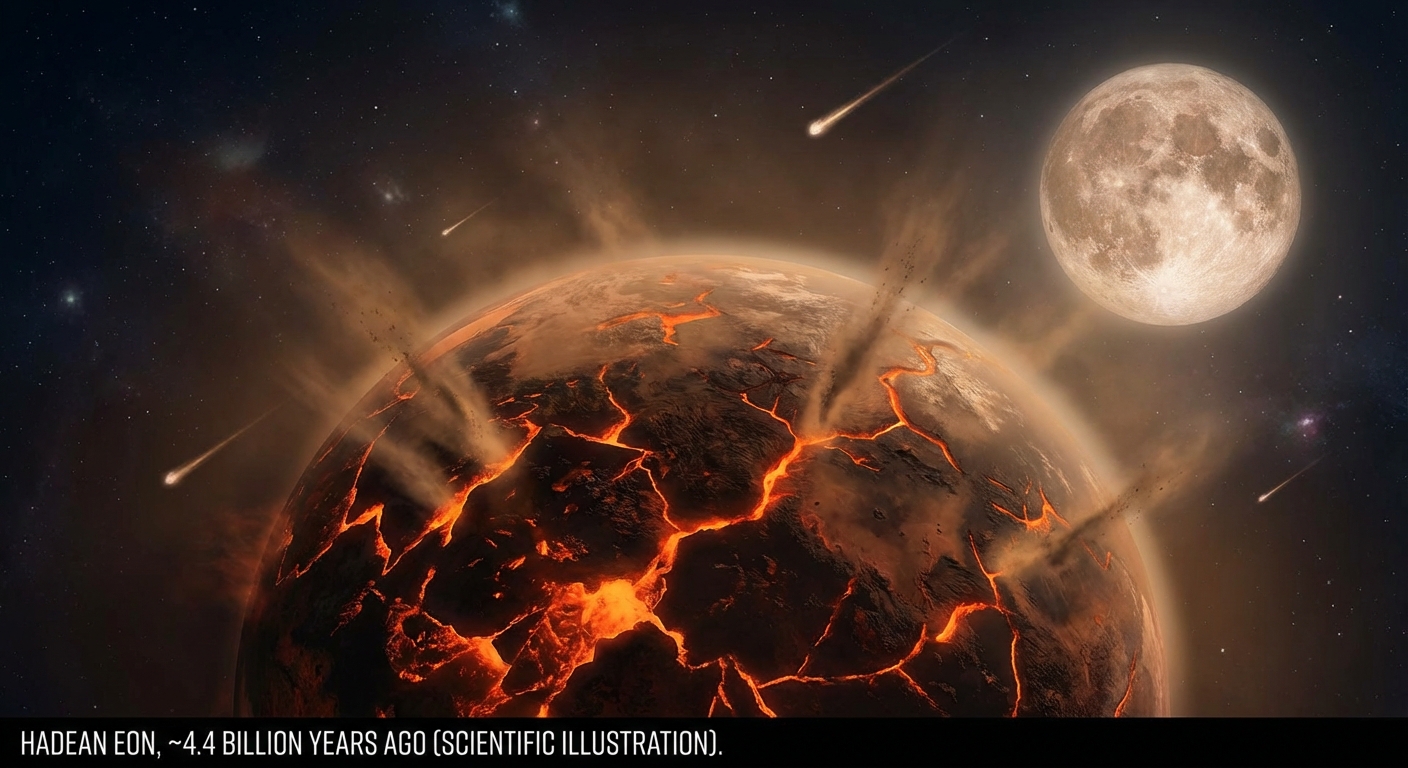
Because of this violence, scientists long assumed that nothing from the Hadean could have survived. The first stable rocks, they believed, couldn’t have formed until after the Late Heavy Bombardment ended around 3.8 billion years ago. The geological record, according to this view, began with the Archean eon. The Hadean was prehistory’s prehistory, a time we could theorize about but never directly observe.
The Nuvvuagittuq discovery challenged that assumption. Rock can survive even in a chaotic world if it’s lucky enough to avoid being subducted, melted, or eroded away over billions of years.
Finding the Oldest Rock
The Nuvvuagittuq greenstone belt was first studied seriously in the early 2000s by Jonathan O’Neil and his colleagues at McGill University. The rocks had been known to geologists for decades, but their extreme age wasn’t appreciated until isotopic dating techniques improved enough to measure it.
Dating rocks this old isn’t simple. The standard method, potassium-argon dating, doesn’t work well on rocks that have been heated or altered over billions of years. Instead, researchers used samarium-neodymium dating, which measures the decay of samarium-146 into neodymium-142. Samarium-146 has a half-life of about 103 million years, which means it was extinct within the first few hundred million years of the solar system’s existence. Any excess neodymium-142 in a rock must have been produced very early, before the samarium ran out.
The Nuvvuagittuq rocks showed significant neodymium-142 anomalies, indicating they formed from material that had differentiated from the mantle during the Hadean. The most robust dates cluster around 4.28 billion years ago, though some researchers prefer a more conservative estimate of 4.16 billion years. Either way, these are the oldest intact rocks ever found on Earth’s surface.

What the Rocks Reveal
The Nuvvuagittuq rocks aren’t just old; they’re informative. Their composition and structure tell us about conditions on the early Earth that we couldn’t learn any other way.
The greenstone belt contains several different rock types, including faux amphibolite (a metamorphosed basalt) and cummingtonite-rich rocks that may have originally been seafloor sediments. The presence of what appear to be ancient sedimentary rocks is particularly significant. Sediments require water, which means liquid water may have existed on Earth’s surface far earlier than previously thought.
Some researchers have even claimed to find evidence of early life in the Nuvvuagittuq rocks. Tiny tube-like structures in the rock, announced in 2017, were interpreted by some as possible microbial fossils. If that interpretation is correct, life on Earth would date back to at least 4.28 billion years ago, emerging almost as soon as conditions permitted. Other scientists remain skeptical, arguing that similar structures can form through purely geological processes. The debate continues.
What’s less controversial is that the Nuvvuagittuq rocks formed in an environment that was more habitable than the Hadean stereotype suggests. By 4.2 billion years ago, parts of Earth’s surface had cooled enough to form solid crust. Water existed in liquid form, either as oceans or smaller bodies. The hellfire was subsiding, and something like a planet was beginning to emerge.
Survivors of the Bombardment
How did these rocks survive when everything else from the Hadean was destroyed? The answer probably involves a combination of luck and location.
The Nuvvuagittuq belt sits on the Superior Craton, one of the oldest and most stable pieces of continental crust on Earth. Cratons are the ancient cores of continents, thick and buoyant enough to resist being pulled into the mantle by subduction. Once a piece of crust attaches to a craton, it can potentially survive for billions of years, riding along as the craton drifts across the globe and other rocks are recycled beneath it.
The rocks also avoided the worst of the metamorphism that has transformed other ancient formations. While they’ve been heated and compressed over the eons, they haven’t been so thoroughly cooked that their original isotopic signatures were erased. This is partly luck and partly the result of being buried deep enough to escape surface erosion while remaining shallow enough to avoid extreme metamorphic temperatures.
Older Than the Oldest
It’s worth noting that the Nuvvuagittuq rocks aren’t the oldest Earth material ever found. That distinction belongs to zircon crystals from the Jack Hills region of Western Australia, some of which date to 4.4 billion years ago, just 150 million years after Earth formed.
But zircons are individual mineral grains, not intact rocks. They crystallized in some ancient magma, then were eroded, transported, and incorporated into younger sedimentary rocks. The original rock that contained them is long gone. The zircons are like messages in bottles that survived after the bottles shattered, carrying information about their origins but no longer attached to their original context.
The Nuvvuagittuq rocks are different. They’re coherent geological formations that preserve not just mineral ages but structural information about the environment in which they formed. You can walk on them, sample different layers, and reconstruct a piece of the ancient landscape. They’re not messages in bottles; they’re pieces of the ship itself.
The Bigger Picture
The Nuvvuagittuq greenstone belt matters because it proves that the Hadean wasn’t entirely lost. Earth preserves more of its history than scientists once thought possible. Other ancient rocks may be waiting to be discovered in remote cratons around the world, each potentially offering new insights into our planet’s earliest days.
The discovery also has implications for astrobiology. If Earth had liquid water and possibly life by 4.2 billion years ago, the window for life’s origin was extremely short. The planet formed 4.54 billion years ago, spent its first few hundred million years as a molten hellscape, and yet somehow had conditions suitable for life almost immediately after cooling. Either life emerges easily given the right conditions, or Earth was extraordinarily lucky.
For now, the Nuvvuagittuq rocks remain a singular window into a lost world. They sit in the remote Canadian wilderness, visited mainly by geologists willing to endure the journey to the eastern shore of Hudson Bay. Most of us will never see them in person. But their existence reminds us that the deep past isn’t entirely gone. Sometimes, if you look in the right places, you can find pieces of the beginning still lying on the surface, waiting to tell their stories to anyone patient enough to listen.
Sources: McGill University geological research, samarium-neodymium isotopic dating studies, Nuvvuagittuq greenstone belt field analyses, Hadean eon geological models.