Look at the sky. Look at the ocean. Blue dominates our visual world in a way no other color does. Yet for most of human history, blue was the hardest color to make. Red came from iron oxide, ochres, and blood. Yellow from sulfur and various plants. Black from charcoal and soot. But blue? Blue required either crushing semi-precious stones or inventing chemistry from scratch. For millennia, blue was rarer than gold.
This scarcity shaped everything from ancient economies to artistic expression to, remarkably, how ancient peoples perceived color itself. The history of blue is a history of ingenuity, trade, war, and the strange plasticity of human perception. It touches Egyptian pharaohs and medieval monks, Afghan mines and German chemists, and ultimately reveals something surprising about the relationship between language, culture, and what we actually see.
The story of blue is not just about pigment. It’s about how scarcity creates value, how technology reshapes aesthetics, and how the words we have for colors may shape the colors we perceive.
The First Blues: Egypt Invents a Color
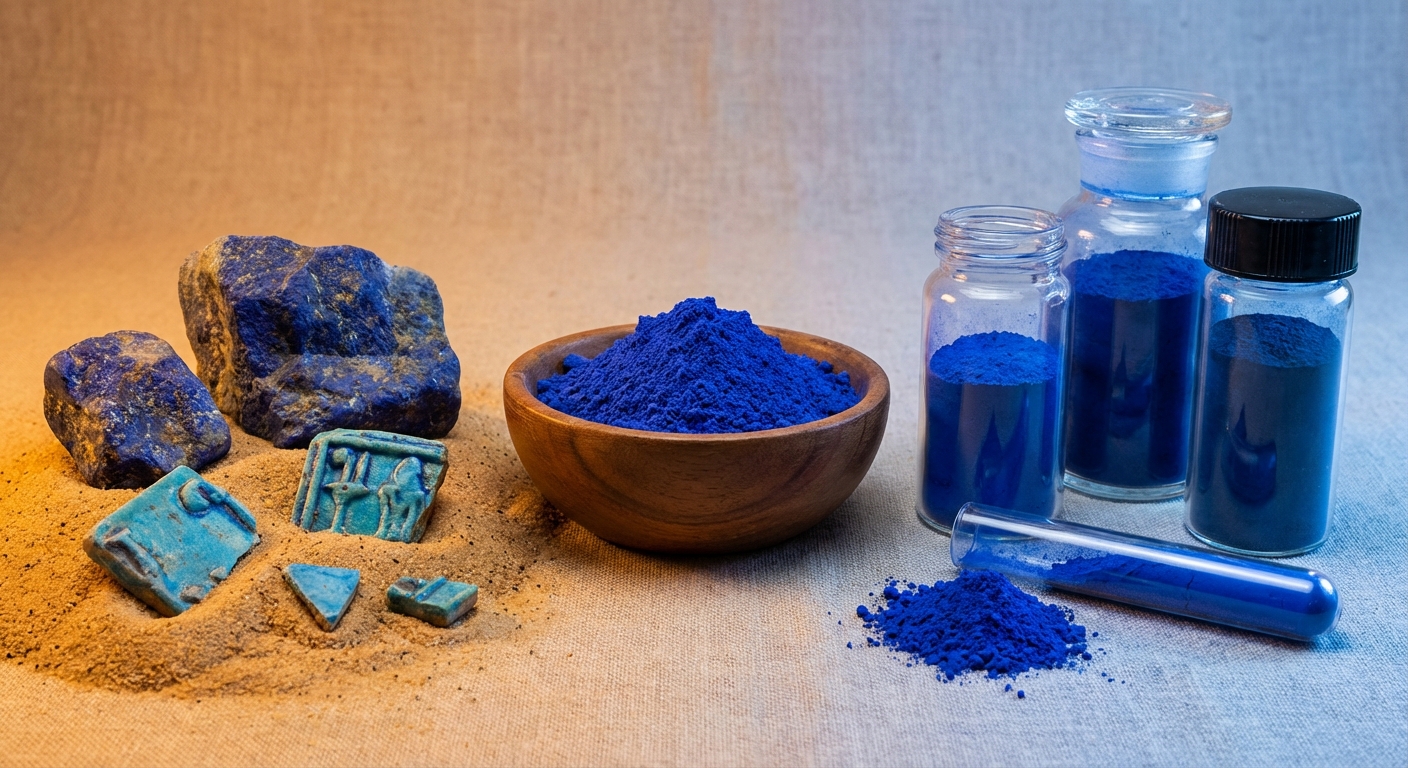
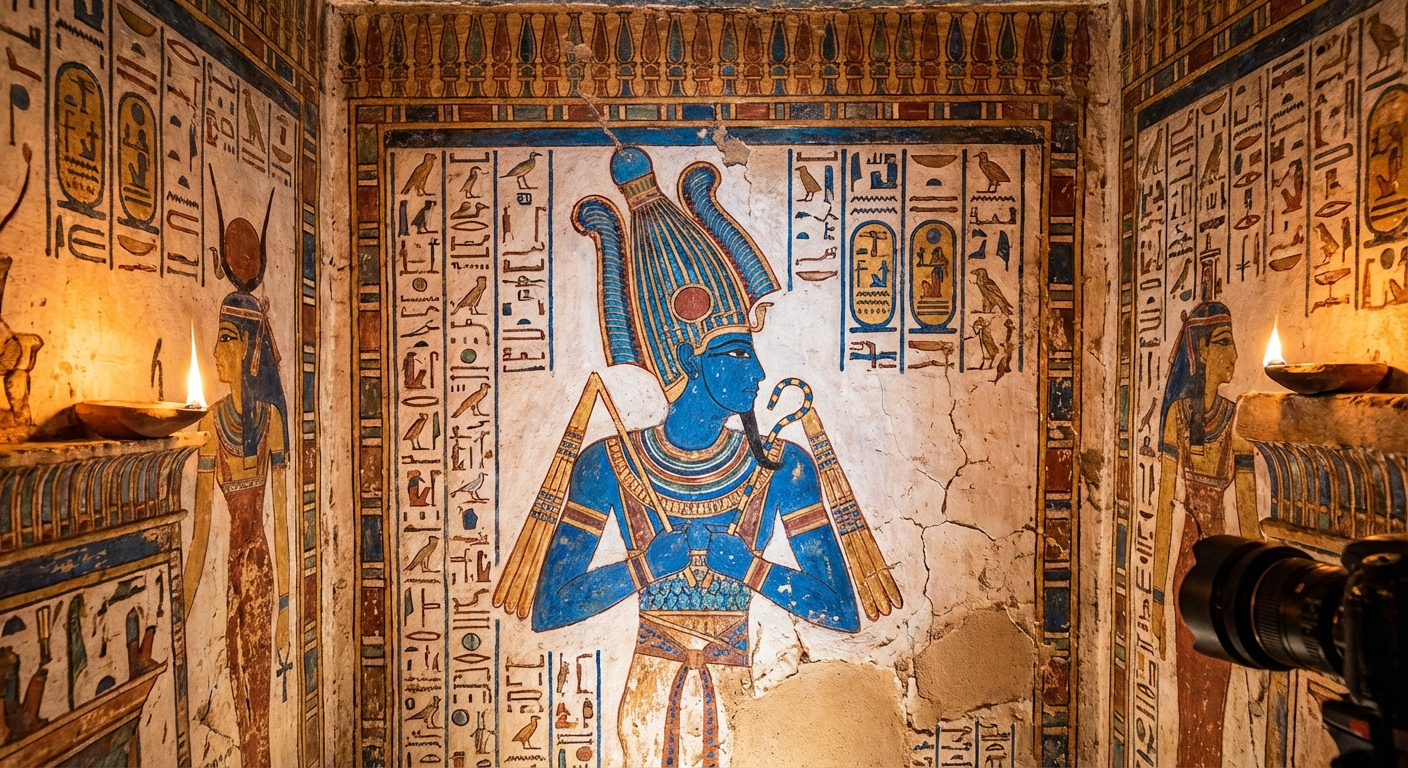
Around 2200 BCE, the Egyptians did something unprecedented: they created a synthetic color. Egyptian blue, also called cuprorivaite, was manufactured by heating sand, copper, and natron (a salt from dried lake beds) to about 1650°F. The result was a vivid, stable blue that could be ground into pigment and applied to everything from tomb paintings to figurines.
This was chemistry before the concept of chemistry existed. The Egyptians had discovered that combining specific materials at specific temperatures produced something entirely new, a substance that didn’t exist in nature but behaved reliably and consistently. They couldn’t explain why the reaction worked in atomic terms, but they didn’t need to. They developed the process empirically, refined it over centuries, and passed the knowledge through generations of craftspeople.
Egyptian blue became ubiquitous in Egyptian art. It colored the skin of gods, the backgrounds of temple paintings, and the iconic stripes of pharaonic headdresses. The pigment was so valuable that it was traded throughout the Mediterranean world. Romans adopted it, using it extensively in their own murals and frescoes. The formula survived the fall of Egypt and spread across the ancient world.
Then, sometime after the Roman Empire’s decline, the knowledge was lost. By the medieval period, no one in Europe knew how to make Egyptian blue anymore. The recipe had vanished, another casualty of the civilizational collapse that swallowed so much ancient knowledge. It wouldn’t be rediscovered until the nineteenth century, when archaeologists began systematically analyzing ancient pigments.
The Lapis Trade: Blue From Afghanistan
Before Egypt’s synthetic innovation, and for most of human history after it, the primary source of true blue pigment was lapis lazuli, a semi-precious stone found in significant quantities in only one place on Earth: the mountains of what is now northeastern Afghanistan. The journey from those mines to the workshops of European painters spanned thousands of miles and multiple civilizations.
Lapis was mined in the Badakhshan region as early as 7000 BCE. The stone was prized across the ancient world, appearing in Mesopotamian artifacts, Egyptian burial masks, and eventually medieval European manuscripts. But transforming lapis into usable pigment was extraordinarily difficult. Simply grinding the stone produces a dull, grayish powder. The blue color is concentrated in specific mineral components that must be separated from the gray matrix through a laborious extraction process.
The technique that medieval Europeans developed involved grinding lapis, mixing it with wax, resin, and oil to form a dough, then kneading this dough underwater. The pure blue particles, being denser, would settle out of the water while impurities remained trapped in the wax. The process could take weeks and produced relatively small amounts of usable pigment from expensive raw material.
The resulting color was ultramarine, from the Latin ultramarinus, meaning “beyond the sea.” The name referenced the stone’s distant origin and its journey across the Mediterranean to reach European artists. Ultramarine was literally worth more than gold. Contracts for Renaissance paintings often specified exactly how much ultramarine the artist would use and who would pay for it. The client typically purchased the pigment separately and handed it over to the artist for application.
This economic reality shaped artistic choices in ways we can still see in surviving paintings. The Virgin Mary is almost always depicted in blue robes, not because of any biblical description but because blue was so expensive that using it signified holiness and importance. Lesser figures received cheaper colors. The theology of color in religious art was partly economics in disguise.
Why Language Matters: Seeing Blue
Here’s where the history of blue gets strange. Linguistic analysis of ancient texts reveals that many cultures didn’t seem to have a word for blue at all. Homer’s famous descriptions of the “wine-dark sea” puzzle modern readers because the sea isn’t wine-colored. But Homer never calls anything blue. The sky in Greek poetry is bronze or iron, never azure.
The same pattern appears across languages. In the Torah, in the Icelandic sagas, in ancient Indian texts, blue is often absent from the vocabulary even when blue objects are being described. The Chinese had a blue word early, as did the Egyptians, who of course manufactured blue pigment. But cultures without access to blue dye or pigment often lacked the linguistic concept.
This has led to a controversial hypothesis: does language shape perception? Can people without a word for blue actually see blue as distinct from green or gray? The idea sounds absurd at first. Blue light hits the eye the same way regardless of what language you speak. But perception isn’t just optical processing; it’s categorization. And categorization is influenced by language.

Studies with the Himba people of Namibia, whose language doesn’t distinguish blue from green with the same boundary English does, suggest subtle but real effects. When shown circles of color and asked to identify the one that’s different, English speakers quickly spot a blue circle among green ones. Himba speakers take longer for the same task but are faster at distinguishing between shades of green that English speakers lump together. The language isn’t determining what the eye registers, but it does seem to influence how quickly and easily perception categorizes colors.
The implications ripple outward. If the Egyptians invented blue pigment partly because they had developed the concept of blue, and if that concept spread alongside the pigment through trade and cultural exchange, then our modern ability to see blue as a distinct category might itself be a cultural invention. The sky was always blue in the physical sense. But blue as we understand it, as a category distinct from green and gray and other adjacent colors, may be an achievement of civilization.
The Modern Revolution: Blue for Everyone
For centuries, ultramarine remained prohibitively expensive, limiting blue’s use to the wealthy and the sacred. That changed in 1826, when French chemist Jean-Baptiste Guimet synthesized ultramarine in a laboratory. Within decades, industrial production made blue pigment affordable for the first time in history.
The impact on art was immediate and visible. Impressionist painters, emerging just as synthetic pigments became widely available, used blue with unprecedented freedom. Monet’s blue shadows, Renoir’s blue-tinged flesh tones, the overall blue-shifted palette of Impressionism would have been economically impossible a generation earlier. The movement’s aesthetic was partly enabled by chemistry.
But the more profound change was cultural. Blue went from a color of the elite to a universal presence. Blue became the color of work clothes (denim, indigo-dyed for durability), of uniforms, of everyday objects. The phrase “blue collar” entered the language. Blue jeans became the most ubiquitous garment on Earth. A color that once signified divinity and royalty became democratic, available to everyone.
Today, blue is the world’s favorite color. Surveys consistently show it topping preference lists across cultures. Whether this reflects some innate preference or centuries of cultural conditioning is hard to disentangle. Blue’s long history as a scarce, valuable, sacred color may have created associations that persist even now that blue is everywhere.
The Bigger Picture
The history of blue illuminates patterns that extend far beyond pigments and paintings. Scarcity creates value, and value shapes culture. When something is rare, we reserve it for what matters most, and through that reservation, we teach ourselves that it matters. The Virgin’s blue robes weren’t blue because blue signified holiness; blue came to signify holiness partly because it was used for Mary’s robes. Value and meaning reinforce each other.
Technology democratizes access, but it also transforms meaning. Synthetic ultramarine didn’t just make blue affordable; it made blue ordinary. The color retained its aesthetic appeal but lost its exclusivity. This pattern repeats across history: spices, silk, sugar, aluminum, countless luxuries became commodities as production methods improved. Each transition changed not just who could access the thing but what the thing meant.
And underlying it all, human perception itself proves more malleable than we assume. We tend to believe that seeing is direct, unfiltered access to reality. But how we see, what we distinguish, what we notice and ignore, is shaped by culture, language, and history. The blue sky was always there. But “blue” as a category of perception, as something distinct from green or gray, may have required centuries of trade, chemistry, and linguistic development to bring into focus.
The next time you glance at something blue, whether a screen, a sky, or a bolt of fabric, you’re seeing the endpoint of a journey spanning millennia. Every blue is the legacy of Egyptian chemists and Afghan miners, of medieval monks kneading lapis in water and French chemists synthesizing crystals in laboratories. Blue was invented, traded, priced beyond gold, and finally democratized. It’s the color that taught us colors themselves are inventions, cultural achievements as much as optical facts.